How to Report Canadian Income in Pakistan Pvt Ltd Tax Return
How to Report Canadian Income in Pakistan Pvt Ltd Tax Return | Business Private Limited Company Tax Return A Pakistan-incorporated Private Limited company operating…
Read more

Running a US LLC from Pakistan does not automatically mean you have no US tax filing responsibilities. Even if you live in Pakistan, have no US office, and operate your business online, your LLC may still need to submit annual tax returns or information reports to the Internal Revenue Service (IRS). Learn US LLC tax filing requirements for Pakistani non-residents, including Form 5472, Form 1120, IRS deadlines, penalties, and annual compliance.
Many Pakistani entrepreneurs form a US Limited Liability Company (LLC) to access international markets, work with overseas clients, use global payment platforms, and build an international business. However, after registration, they often overlook annual compliance requirements.
The important point is that US LLC registration and US tax filing are two different responsibilities. Your filing requirements depend on your LLC’s ownership structure, tax classification, business activities, income sources, and transactions with foreign owners or related parties.
This guide explains the annual IRS filing requirements for Pakistani non-residents who own a US LLC, including Form 5472, pro forma Form 1120, Form 1065, Form 1120, Form 1040-NR, filing deadlines, penalties, and Pakistan tax considerations.
If you have not registered your company yet, first read our guide to US LLC formation for non-residents.
Yes, a Pakistani non-resident who owns a US LLC may have annual US tax filing responsibilities. However, the exact forms depend on how the LLC is classified for federal tax purposes.
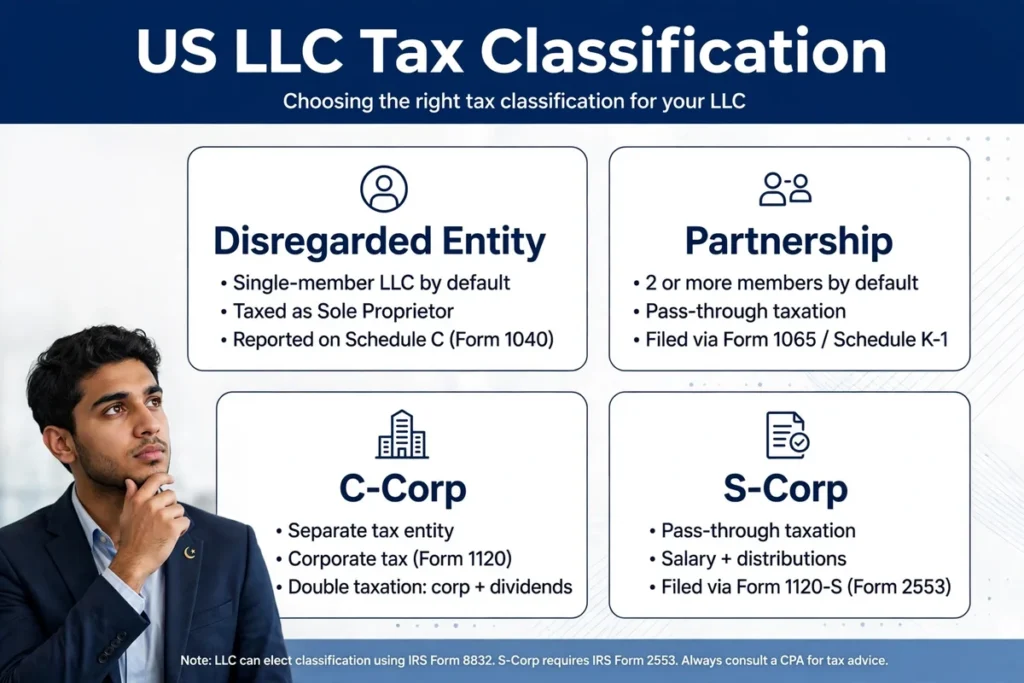
A US LLC does not automatically pay federal income tax as a separate entity. The IRS generally treats an LLC according to its number of owners and any tax classification election it has made.
For example:
A foreign-owned single-member LLC may also have to file Form 5472 with a pro forma Form 1120 when it has reportable transactions with its foreign owner or related parties.
Therefore, having no US income does not automatically mean that you have no filing obligations.
Before preparing any tax return, it is important to identify your LLC’s federal tax classification.
A single-member LLC has one owner. Unless it elects corporate tax treatment, the IRS generally treats it as a disregarded entity.
This means the LLC is generally not treated as a separate taxpayer for federal income tax purposes. However, a foreign-owned US single-member LLC may still have separate information-reporting obligations.
For example, if a Pakistani individual owns 100% of a US LLC and contributes money to the company, transactions between the owner and LLC may create Form 5472 reporting requirements.
A multi-member LLC has two or more owners. Unless it elects corporate treatment, it is generally classified as a partnership for federal tax purposes.
The LLC may need to file Form 1065 and provide Schedule K-1 to its members.
Foreign partners may also have individual US tax and withholding considerations, depending on the partnership’s activities and income.
An LLC can elect to be taxed as a C corporation by filing the relevant IRS election.
In that situation, the company generally files Form 1120 and pays corporate income tax on its taxable income.
A foreign-owned corporation may also have Form 5472 reporting requirements when it has reportable transactions with foreign related parties.
For company formation, tax classification, and related compliance assistance, see our Company Formation in the USA services.
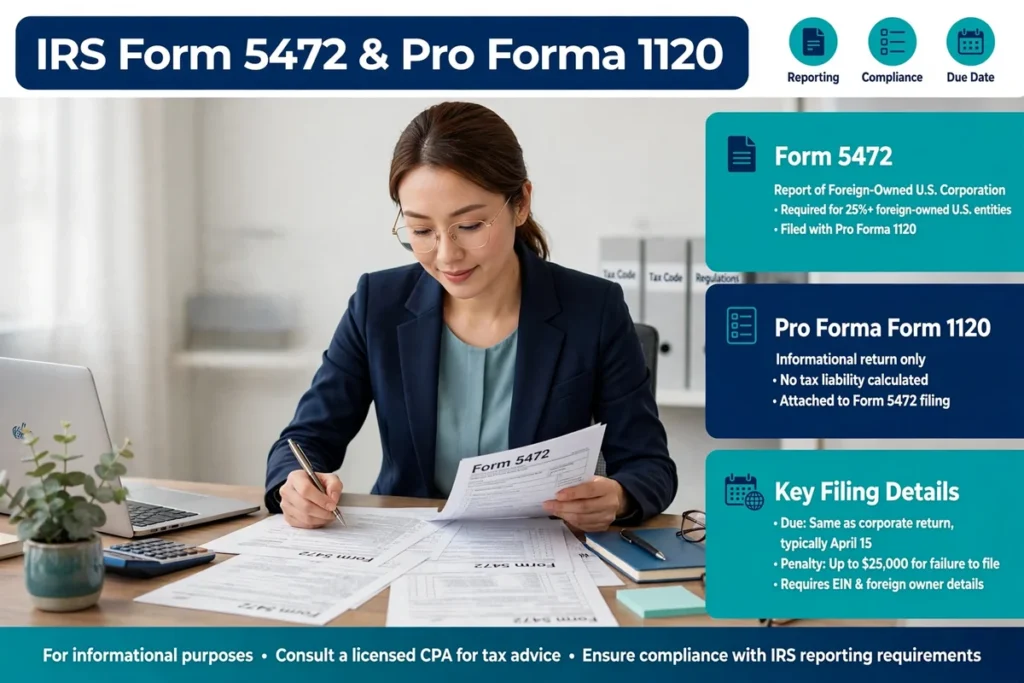
Form 5472 is an information return used by certain US corporations to report transactions with foreign related parties.
A foreign-owned US disregarded entity that is wholly owned by a foreign person can also be treated as a reporting corporation for these reporting requirements.
This is particularly important for Pakistani entrepreneurs who own a US single-member LLC.
Form 5472 generally reports transactions between the LLC and its foreign owner or other related parties. These transactions may include:
The exact reporting treatment depends on the nature of the transaction and applicable IRS rules.
Important: Form 5472 is an information-reporting form. It does not automatically mean that the LLC owes federal income tax. However, failing to file a required Form 5472 can result in significant penalties.
The IRS explains the foreign-owned disregarded entity filing requirements in its Instructions for Form 5472. Internal Revenue Service+1
A foreign-owned single-member LLC that is treated as a disregarded entity may need to submit Form 5472 attached to a pro forma Form 1120.
A pro forma Form 1120 is not the same as a regular corporate income tax return.
It is used as the filing cover for Form 5472 in this situation. The foreign-owned disregarded entity generally completes only the specific identifying information required by the IRS instructions.
The company should write “Foreign-owned U.S. DE” across the top of the pro forma Form 1120.
The filing must follow the special instructions and submission methods applicable to foreign-owned US disregarded entities. The IRS currently provides a dedicated fax number and mailing address for these filings, rather than the ordinary Form 1120 filing address.
A foreign-owned disregarded entity cannot use the ordinary electronic filing process for Form 5472 described for other filers. Always check the current IRS instructions before submitting the return. Internal Revenue Service+1
This is one of the most common questions among Pakistani LLC owners.
A foreign-owned single-member LLC may have a Form 5472 filing requirement even if:
The key issue is not simply whether the LLC earned income. It is whether the company had reportable transactions with its foreign owner or another related party.
For example, consider a Pakistani entrepreneur who forms a US LLC and transfers money from a personal bank account to the LLC to pay for registration, software, or business expenses.
That transfer may need to be evaluated as a reportable transaction.
Similarly, payments made by the LLC to its foreign owner or certain related parties may need to be reported.
Do not assume that an inactive LLC has no filing obligations. Review the company’s ownership, financial records, and transactions before deciding whether a return is required.
A foreign-owned LLC should maintain clear records of transactions between the company and its foreign owner or related parties.
Common examples include:
| Transaction | What to review |
|---|---|
| Initial capital contribution | Money transferred by the owner to the LLC |
| Additional investment | Further funds provided by the owner |
| Owner withdrawals | Money transferred from the LLC to the owner |
| Owner loans | Loans between the company and its owner |
| Related-party payments | Payments to qualifying related parties |
| Service payments | Payments for services between related parties |
| Reimbursements | Expenses paid personally and reimbursed by the LLC |
The tax treatment and reporting category depend on the transaction’s actual nature.
Keep bank statements, transfer confirmations, invoices, agreements, and accounting records to support the information reported to the IRS.
If your LLC has multiple members and is classified as a partnership, its annual filing requirements are different from those of a single-member disregarded entity.
A partnership generally files:
Schedule K-1 reports each partner’s allocated share of the partnership’s income, deductions, credits, and other tax items.
A foreign partner may have additional US tax obligations if the partnership conducts a US trade or business or allocates effectively connected income to that partner.
Partnerships with foreign partners may also have withholding and reporting responsibilities under applicable IRS rules.
You should not use the single-member LLC Form 5472 procedure as a substitute for the partnership filing requirements.
The IRS provides further information in its Instructions for Form 1065. Internal Revenue Service
Some Pakistani entrepreneurs choose corporate tax treatment for their US LLC.
If the LLC elects to be taxed as a C corporation, it generally becomes subject to corporate income tax filing requirements.
The company generally files Form 1120 to report:
A corporation may owe US federal income tax on its taxable income. It may also have state-level tax and reporting responsibilities.
If the corporation is foreign-owned and has reportable transactions with foreign related parties, Form 5472 may also be required.
The correct tax treatment should be reviewed before making an election because changing an LLC’s classification can affect its tax responsibilities.
Form 1040-NR is the US Nonresident Alien Income Tax Return.
A Pakistani individual who is not a US tax resident may need to file Form 1040-NR if they have income or activities that create a US individual income tax filing obligation.
However, simply owning a US LLC does not automatically mean that the owner must file Form 1040-NR.
The requirement depends on the individual’s circumstances, including whether they are engaged in a US trade or business and whether they receive income that is taxable in the United States.
Two important income categories are:
Effectively Connected Income (ECI): Income effectively connected with a US trade or business. It is generally taxed after allowable deductions at applicable graduated rates.
Fixed, Determinable, Annual, or Periodical (FDAP) Income: Certain US-source income that is not effectively connected with a US trade or business may be subject to a 30% gross-basis tax, or a lower treaty rate where applicable.
A nonresident alien who is required to file a US individual income tax return generally uses Form 1040-NR.
The IRS explains these rules in its guidance on taxation of nonresident aliens. Internal Revenue Service+2
Missing a filing deadline can create unnecessary penalties and compliance problems.
The deadline depends on the LLC’s tax classification and tax year.
| Filing | General calendar-year deadline |
|---|---|
| Form 5472 with pro forma Form 1120 for foreign-owned disregarded entity | April 15 |
| Form 1065 for a calendar-year partnership | March 15 |
| Form 1120 for a calendar-year C corporation | April 15 |
| Form 1040-NR for certain nonresident individuals | Generally April 15 or June 15, depending on circumstances |
These are general deadlines for calendar-year filers. Different tax years, weekends, holidays, extensions, and individual circumstances can change the applicable date.
For a foreign-owned disregarded entity, Form 7004 may be used to request an extension for the Form 5472/pro forma Form 1120 filing. The extension request must be submitted by the regular due date.
An extension to file does not automatically extend the time to pay any tax that may be due. Internal Revenue Service+2
The IRS can impose a substantial penalty for failing to file Form 5472 when required.
The general initial penalty is $25,000 for each failure to file the form on time and in the required manner.
A substantially incomplete Form 5472 may also be treated as a failure to file.
Additional penalties may apply if the failure continues after the IRS issues a notice.
This is why foreign-owned LLC owners should not ignore annual information-reporting requirements, even when the company has no revenue or taxable profit.
The IRS also recognises reasonable-cause relief in qualifying circumstances, but relief is not automatic. A taxpayer must meet the applicable requirements and provide supporting facts. Internal Revenue Service+1
Preparing an accurate filing requires complete business and ownership records.
Pakistani non-residents should organise the following documents before beginning the annual compliance process.
Company documents
Financial records
Foreign-owner information
If you need assistance with EIN registration, company formation, or US compliance, explore our USA company formation services.
A proper filing process begins with reviewing the company’s structure and financial activity.
Determine whether your LLC is treated as a disregarded entity, partnership, or corporation for federal tax purposes.
Do not assume that the LLC’s state registration documents determine its federal tax classification.
Confirm the legal owner or owners, ownership percentages, and any changes during the tax year.
Changes in ownership may affect reporting requirements.
Gather bank statements, payment processor records, invoices, expense receipts, and accounting reports.
Make sure that personal and business transactions are properly identified.
Review transfers between the LLC and its foreign owner or other related parties.
Identify capital contributions, distributions, loans, reimbursements, and other transactions that may require reporting.
Depending on the LLC’s tax classification and activities, the required filings may include:
Not every LLC needs to submit every form.
Check the information for accuracy and consistency with the company’s supporting records.
Incorrect ownership details, missing transactions, and incomplete forms can create compliance problems.
Use the correct IRS filing procedure and address for the specific form and entity type.
Keep proof of submission, copies of the forms, and supporting documents.
Federal tax filing is only one part of US LLC compliance.
A company may also have state-level obligations depending on where it was formed, where it conducts business, and the nature of its activities.
Possible state responsibilities include:
For example, an LLC registered in one state may still have obligations in another state if it conducts business there or otherwise meets that state’s registration or tax rules.
State requirements are different. Do not assume that filing federal forms automatically completes state compliance.
Pakistani tax responsibilities should be considered separately from US federal and state filing requirements.
Your Pakistan tax position may depend on factors such as:
A Pakistani tax resident may have different reporting responsibilities from a Pakistani citizen who is a non-resident for tax purposes.
Therefore, do not assume that registering a US LLC automatically makes all business income exempt from Pakistani tax.
For help reviewing Pakistan-side tax and compliance matters, see our Taxation Services and Company Registration in Pakistan pages.
Section 116A of Pakistan’s Income Tax Ordinance, 2001 deals with foreign income and assets statements for individuals who meet the applicable legal conditions.
It is relevant to some Pakistani tax residents who hold overseas assets or earn foreign income.
However, the reporting requirement does not apply automatically to every Pakistani who owns a foreign company. The person’s tax residency, income, assets, and statutory thresholds must be reviewed.
A Pakistani entrepreneur with a US LLC should maintain records of their foreign ownership, income, bank accounts, and relevant transactions so that their Pakistan-side tax reporting can be assessed accurately.
The US LLC’s IRS filing and the individual’s Pakistani tax reporting are separate compliance matters.
Foreign business owners can create compliance issues by misunderstanding the difference between company registration, income tax, and information reporting.
Common mistakes include:
1. Assuming no revenue means no filing
A foreign-owned disregarded LLC may still have Form 5472 obligations when reportable transactions exist.
2. Ignoring owner contributions
Money transferred by the owner to the LLC should be recorded and reviewed for reporting purposes.
3. Mixing personal and business expenses
Using one account for personal and business transactions makes accounting and tax reporting more difficult.
4. Filing the wrong IRS form
A single-member disregarded LLC, a multi-member partnership, and a corporation do not necessarily have the same filing requirements.
5. Missing annual deadlines
Late filings can lead to penalties and unnecessary correspondence with the IRS.
6. Ignoring state compliance
Federal filing does not replace state annual reports, franchise taxes, or other state obligations.
7. Failing to maintain records
Bank statements, invoices, contracts, and transfer records should be retained to support tax filings.
8. Assuming that LLC ownership automatically requires Form 1040-NR
The owner’s individual filing obligations depend on their income and activities, not merely on ownership of an LLC.
If you have missed a filing deadline, do not ignore the issue.
Start by identifying which forms were required and which tax years are affected.
A practical review should include:
Reasonable-cause relief may be available in qualifying cases, but the facts and supporting evidence matter.
If you have received an IRS notice or discovered an unfiled return, get the filing position reviewed before submitting incomplete or incorrect forms.
Use this checklist to organise your annual compliance work.
| Compliance task | What to check |
|---|---|
| LLC ownership | Confirm owners and ownership percentages |
| EIN | Keep the IRS confirmation and company details |
| Accounting | Reconcile income, expenses, and bank activity |
| Owner transactions | Record contributions, withdrawals, and loans |
| Form 5472 | Review whether filing is required |
| Pro forma Form 1120 | Attach when required for a foreign-owned disregarded entity |
| Form 1065 | Review for multi-member partnership LLCs |
| Form 1120 | Review for LLCs taxed as corporations |
| Form 1040-NR | Assess the owner’s individual filing position |
| State compliance | Check annual reports and state taxes |
| Pakistan reporting | Review foreign income and asset obligations |
| Records | Retain filed returns and supporting documents |
The checklist is a starting point, not a substitute for reviewing the LLC’s actual tax classification and activities.
Owning a US LLC from Pakistan can create several compliance responsibilities. Understanding which forms apply, preparing accurate records, and meeting the correct deadlines can be challenging, especially when you are managing an international business remotely.
Legal Point Consultants provides business formation, taxation, accounting, and compliance support for entrepreneurs who want to establish and manage international business operations.
Our services can help with:
Our goal is to help business owners understand their responsibilities and maintain organised company records.
Explore our services or contact Legal Point Consultants to discuss your US LLC tax filing requirements.
Beneficial Ownership Information (BOI) reporting is a separate compliance issue from IRS tax filing.
FinCEN’s rules changed significantly in 2025 and again in 2026. According to FinCEN’s update dated August 11, 2026, US-created companies are exempt from BOI reporting under the final rule effective August 14, 2026. Certain foreign companies registered to do business in the United States may still have reporting obligations. FinCEN.gov+2
This means a Pakistani entrepreneur who owns a US-created LLC should not rely on older online articles that say every US LLC must file a BOI report.
However, the company should still check whether any specific registration structure or foreign-company status creates a reporting obligation.
Remember: BOI reporting and IRS tax filing are different systems. An exemption from BOI reporting does not remove Form 5472, income tax, state tax, or other applicable compliance requirements.
For the latest position, consult the official FinCEN BOI guidance.
A Pakistani citizen who owns a US LLC may have US tax filing responsibilities. The exact requirements depend on the LLC’s federal tax classification, ownership, business activities, and reportable transactions.
A foreign-owned US single-member LLC treated as a disregarded entity generally needs to file Form 5472 with a pro forma Form 1120 when it has reportable transactions with its foreign owner or related parties.
Possibly. The requirement is not based only on business revenue. Reportable transactions between the LLC and its foreign owner or related parties can create a filing obligation even when the LLC has no income.
The general initial penalty is $25,000 for failing to file Form 5472 when required. Additional penalties may apply if the failure continues after IRS notification.
Form 5472 reports certain transactions between a US reporting corporation and foreign related parties. A foreign-owned disregarded entity attaches Form 5472 to a pro forma Form 1120. A regular corporation uses Form 1120 to report its corporate income tax information.
Not automatically. A Pakistani non-resident may need Form 1040-NR if their US income or activities create an individual US income tax filing requirement.
For a foreign-owned disregarded entity using a calendar tax year, Form 5472 with the pro forma Form 1120 is generally due April 15. An extension may be requested using Form 7004, subject to IRS rules.
An inactive LLC may still have information-reporting, state annual report, or other compliance responsibilities. Its actual obligations should be reviewed before assuming that no filing is necessary.
Many foreign entrepreneurs manage their US LLCs remotely. However, remote management does not automatically remove US tax, state, banking, or other legal obligations.
Legal Point Consultants can assist with company formation, tax compliance coordination, accounting, and related business services. Contact the team to discuss your LLC’s ownership structure and filing requirements.
A US LLC can provide Pakistani entrepreneurs with an opportunity to operate internationally, but company registration is only the first step. Annual tax filing and compliance should be part of your business management process.
If your LLC is foreign-owned, you should understand how Form 5472, pro forma Form 1120, partnership returns, corporate tax returns, and individual nonresident tax filings apply to your situation.
The most important step is to identify your LLC’s correct tax classification and review all transactions between the company and its foreign owner.
Maintaining accurate accounting records, reviewing filing deadlines, and preparing the correct IRS forms can help you avoid unnecessary compliance problems.
Need help with US LLC tax filing from Pakistan? Contact Legal Point Consultants to discuss your annual IRS filing and compliance requirements.
 Taxation & Compliance
How to Report Canadian Income in Pakistan Pvt Ltd Tax Return | Business Private Limited Company Tax Return A Pakistan-incorporated Private Limited company operating…
Read more Company Formation
SECP Annual Compliance for Pvt Ltd Company Doing Canada Business A Pakistan-registered private limited company must continue meeting its SECP annual compliance requirements even…
Read more Taxation & Compliance
UAE Corporate Tax Registration for New Companies: Requirements, Process and Deadlines (2026 Guide) Starting a new company in the UAE involves more than obtaining…
Read more