Non-Resident with a UK Company? Avoid These 4 Costly Mistakes
Owning a UK company while living outside the United Kingdom can be an attractive option for international entrepreneurs, consultants, technology founders and online businesses.…
Read more
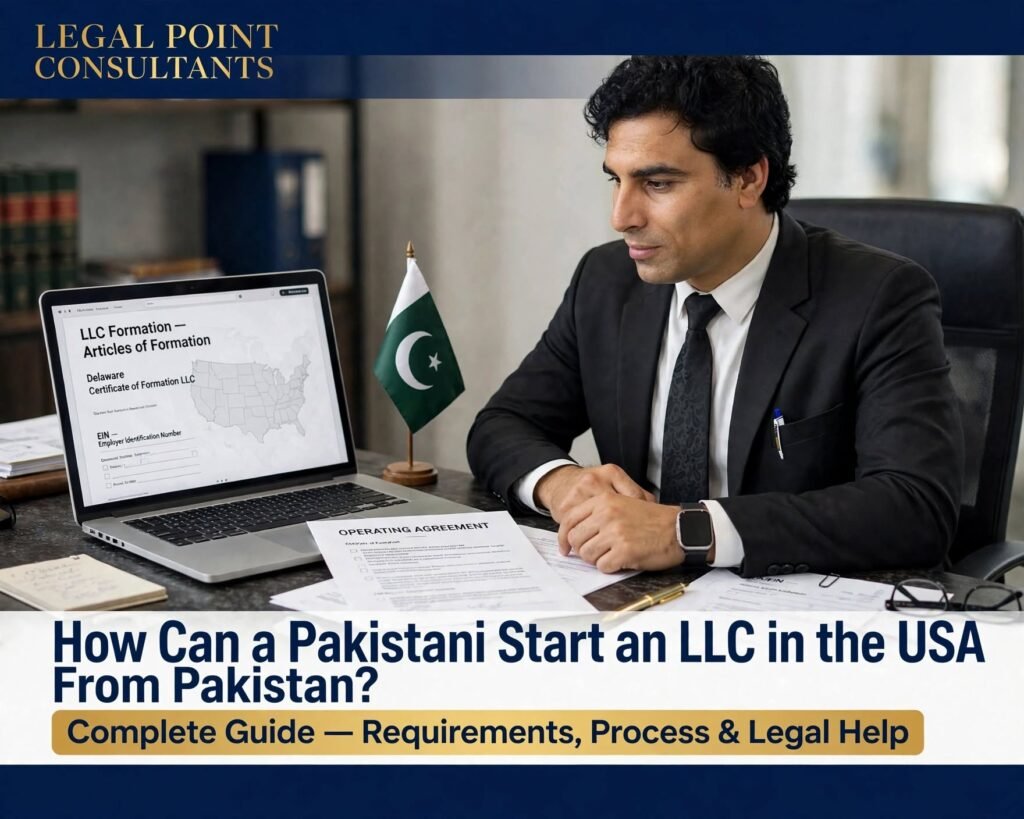
A Pakistani entrepreneur does not necessarily need to travel to the United States to establish a U.S. Limited Liability Company (LLC). In many situations, a non-U.S. resident can form an LLC through the relevant U.S. state filing process and manage the business from Pakistan. However, start LLC in USA from Pakistan involves more than simply registering a company online.
The entrepreneur needs to choose an appropriate state, select a compliant business name, appoint a registered agent, prepare formation information, file the required state document, obtain an Employer Identification Number (EIN) where appropriate, understand federal and state tax obligations, and arrange banking or payment solutions.
There is also a separate question that Pakistani residents should consider: how will the investment and income associated with the U.S. business be treated under Pakistani law? Pakistan’s tax framework includes rules concerning foreign income and assets for qualifying resident individuals, while State Bank of Pakistan rules can also be relevant to investment abroad. These issues should not be ignored simply because the LLC is incorporated in the United States.
This guide explains how a Pakistani entrepreneur can approach U.S. LLC formation from Pakistan, what documents may be required, whether a U.S. visa is necessary, how EIN and tax compliance work, and what should be considered before sending money or operating the company.
Yes, a Pakistani entrepreneur can generally form a U.S. LLC without becoming a U.S. resident.
U.S. LLCs are formed under state law rather than through one single federal company-registration system. The entrepreneur normally chooses a state, checks the proposed business name, appoints a registered agent in that state, prepares the formation filing, pays the applicable state fee, and receives confirmation once the LLC is formed.
The U.S. Small Business Administration explains that LLCs need a registered agent located in the state where the business is registered and that businesses generally file formation documents with the relevant state authority.
This means that being physically located in Pakistan does not, by itself, prevent a person from owning a U.S. LLC.
The more important questions are:
Generally, forming an LLC does not itself require the owner to obtain a U.S. visa or become a U.S. resident.
A Pakistani entrepreneur can potentially own a U.S. business while remaining in Pakistan.
However, company ownership and immigration status are separate matters.
Owning a U.S. LLC does not automatically give the owner:
If the owner later wants to physically travel to the United States to perform activities there, immigration rules may become relevant depending on the purpose and circumstances of the visit.
Therefore, an entrepreneur should not treat LLC formation as an immigration program.
A U.S. LLC may be considered for a variety of legitimate business reasons.
For example, a Pakistani entrepreneur may operate:
The actual suitability of a U.S. LLC depends on the business model.
A U.S. LLC is not automatically the right structure for every Pakistani business.
Before formation, the entrepreneur should determine whether a U.S. entity actually solves a business problem.
The first step should not be paying a formation service.
Start by understanding the business.
Ask:
A software company may have different tax, licensing and operational considerations from an e-commerce business.
If customers are primarily in the United States, a U.S. entity may be considered for commercial reasons.
A Pakistani entrepreneur running the entire business from Pakistan should not assume that forming a U.S. LLC automatically moves the business activity or tax obligations out of Pakistan.
A single Pakistani individual may form a single-member LLC, while multiple owners may require a multi-member structure.
Payment flows between Pakistan, the United States and other countries can create banking, foreign-exchange and tax considerations.
These questions should be answered before choosing the company structure.
A U.S. LLC is generally formed under the law of a particular state.
There is no single nationwide LLC registration that replaces state formation.
The entrepreneur should compare:
The SBA notes that if an LLC conducts business in more than one state, it may need to qualify as a foreign business in additional states.
International entrepreneurs frequently encounter states such as:
However, the most suitable state depends on the actual business.
A Pakistani entrepreneur should not choose a state solely because an online formation company advertises it as “the cheapest” or “best.”
For example, if the company is actually conducting business in another U.S. state, forming the LLC in a different state may not eliminate registration obligations where the business operates.
The proposed business name must satisfy the naming rules of the chosen state.
Before filing, check:
State name availability does not necessarily mean that the name is free from trademark issues.
An entrepreneur should therefore consider both state registration and intellectual-property considerations.
A U.S. LLC generally needs a registered agent in the state where it is formed.
The SBA explains that the registered agent receives official papers and legal documents on behalf of the company and must be located in the state of registration.
For a Pakistani entrepreneur living in Pakistan, using a professional registered-agent service may therefore be practical.
The registered agent is not necessarily the owner or manager of the LLC.
This distinction is important.
A registered agent’s role is primarily to receive official correspondence and legal documents as required by state law.
The formation filing generally contains information required by the relevant state.
Depending on the state and structure, information may include:
The precise requirements vary by state.
The entrepreneur should use the official Secretary of State or equivalent state authority for the applicable filing requirements.
The LLC is formally created by filing the relevant formation document with the state.
Depending on the jurisdiction, this may be called:
The name differs by state.
After approval, the state generally issues evidence that the LLC has been formed.
This document becomes an important part of the company’s records.
An Operating Agreement describes how the LLC is owned and managed.
Even where a particular state does not require an Operating Agreement to be filed publicly, having one can be useful for establishing the internal rules of the company.
It can address matters such as:
For a single-member LLC, the agreement can still help document ownership and management arrangements.
An EIN is the federal tax identification number used for a business entity.
A Pakistani owner may need an EIN for the LLC depending on the circumstances and tax/reporting requirements.
The IRS explains that an EIN identifies a business entity for federal tax purposes.
A non-U.S. owner does not automatically need an SSN simply because they want to establish a U.S. LLC.
The IRS’s current guidance states that foreign individuals are not required to have an ITIN to receive an EIN and, where the responsible party does not have or is not eligible for an ITIN or SSN, the applicant may use “foreign” or “N/A” as directed in the applicable Form SS-4 instructions.
The EIN process therefore needs to be completed accurately rather than by entering a random U.S. taxpayer number.
A common structure for a Pakistani entrepreneur is a single-member LLC.
For U.S. federal income-tax purposes, a domestic single-member LLC is generally treated as a disregarded entity unless it elects another classification.
The IRS explains that a single-member LLC can be treated as a disregarded entity for federal income-tax purposes.
But this does not mean the company has no tax or reporting obligations.
This is one of the biggest misconceptions about U.S. LLC formation.
A foreign-owned U.S. LLC can have information-reporting requirements even where the LLC does not owe federal income tax in the way the owner expects.
A foreign-owned U.S. single-member LLC can fall within special information-reporting rules.
The IRS instructions explain that a wholly foreign-owned U.S. disregarded entity may have to file Form 5472 for reportable transactions and a pro forma Form 1120 attached to the Form 5472.
This can become relevant to transactions between the LLC and its foreign owner or other related parties.
Examples can include certain:
The exact treatment depends on the transaction and tax classification.
Therefore, a Pakistani owner should not assume:
“My LLC made no U.S. taxable profit, so I have nothing to file.”
That conclusion can be incorrect.
U.S. tax compliance should be assessed based on the actual ownership structure, activities and transactions.
Federal tax compliance is only one part of maintaining an LLC.
The state where the LLC is formed may impose:
If the company operates in another state, it may also have foreign qualification obligations there.
The SBA notes that businesses operating across multiple states may need foreign qualification and can face taxes and annual-report requirements in both the formation state and other states where they qualify.
This is why “cheap LLC formation” does not necessarily mean “cheap business operation.”
Beneficial Ownership Information, commonly called BOI, has been subject to significant regulatory changes.
As of August 2026, FinCEN states that companies created in the United States are exempt from federal BOI reporting requirements under the current rule. The current rule instead focuses on certain foreign entities that are formed under foreign law and registered to do business in the United States.
Therefore, older online articles saying that every U.S.-formed LLC owned by a Pakistani must file a BOI report should not automatically be followed.
The rules have changed.
A Pakistani entrepreneur should check the current FinCEN requirements at the time of formation rather than relying on outdated 2024 or 2025 guides.
After forming the LLC and obtaining the necessary tax identification information, the owner may explore business banking and payment solutions.
This is often one of the more difficult parts for a non-U.S. resident.
A bank or financial platform may request:
Approval is not guaranteed merely because an LLC exists.
Each bank or payment provider applies its own onboarding, KYC and risk requirements.
A formation agent should therefore not promise that a Pakistani owner will automatically receive a particular U.S. bank account.
Potentially, yes, depending on the bank or financial institution.
Some institutions offer remote onboarding for eligible non-U.S. founders, while others may require additional verification or an in-person visit.
The important distinction is:
LLC formation and bank-account approval are two separate processes.
Forming the LLC does not guarantee approval for:
The provider’s own eligibility rules apply.
A typical formation and compliance process may involve:
Additional documentation may be required depending on the state, bank, payment provider and business activity.
There is no single fixed price for every Pakistani entrepreneur.
The total cost can include:
State filing fees vary, and the SBA notes that business registration costs differ by state and business structure.
Therefore, a realistic budget should include ongoing compliance, not just the initial formation fee.
The formation timeline depends on:
The LLC formation itself may be relatively quick in some states, but the complete process—from company formation through EIN, banking and tax setup—can take longer.
Entrepreneurs should therefore avoid providers promising that every stage will be completed within a fixed number of hours.
No.
This is an important point.
Creating a U.S. LLC does not automatically remove Pakistani tax obligations.
Pakistan’s tax law contains provisions dealing with foreign income and assets. Under Section 116A of Pakistan’s Income Tax Ordinance, a resident individual meeting the specified thresholds for foreign income or foreign assets is required to furnish a foreign income and assets statement containing prescribed information.
Pakistan also has Controlled Foreign Company provisions under Section 109A. Those rules can potentially attribute certain income of qualifying foreign companies to a resident person when the statutory conditions are satisfied.
Whether a particular Pakistani entrepreneur is affected depends on their:
Therefore, a U.S. LLC should not be marketed as a way to “avoid Pakistani taxes.”
The correct approach is to evaluate the cross-border tax position before establishing the company.
This is another area that requires attention.
U.S. company formation and funding the company from Pakistan are separate issues.
Pakistan’s foreign-exchange framework contains rules governing investment abroad by residents. SBP has issued rules and amendments concerning equity investment abroad, including provisions intended to facilitate certain export-oriented businesses and IT companies.
The applicable route can depend on:
A Pakistani resident should therefore discuss the funding route with an authorized bank and qualified Pakistani tax/foreign-exchange adviser before transferring substantial capital abroad.
Yes, a Pakistani entrepreneur can operate a U.S. LLC while remaining in Pakistan, subject to the laws and regulations applicable to the business.
For example, the owner might:
But operating from Pakistan creates an important distinction:
The company being incorporated in the United States does not automatically mean all business activity takes place in the United States for tax purposes.
The location of management, employees, contractors, customers, assets, offices and actual business activities can matter.
This is why cross-border tax planning should be completed before assuming a particular tax result.
A registered agent address is required in the formation state, but a registered-agent address is not necessarily the same thing as the owner’s residential address or the company’s actual operating location.
The requirements depend on the state, bank and service provider.
A Pakistani entrepreneur should also avoid using a random or misleading address simply to make the company appear U.S.-based.
Business addresses should accurately reflect the company’s arrangements and satisfy the requirements of the relevant authority or financial institution.
The cheapest formation fee does not necessarily produce the lowest overall compliance cost.
An LLC can have federal, state and foreign-country tax and reporting implications.
Foreign-company ownership can create Pakistani tax and disclosure questions for residents.
The IRS requires the responsible party to be correctly identified. A nominee should not be improperly listed as the responsible party.
Many online articles contain outdated BOI instructions. FinCEN’s current 2026 rule exempts U.S.-created companies from federal BOI reporting.
Company formation does not guarantee banking approval.
An LLC can remain legally formed while the owner fails to maintain required state or federal compliance.
Separate business finances can make accounting, documentation and tax compliance easier.
KYC and company information should be accurate and consistent across formation, tax and banking documents.
There is no universal answer.
A Pakistani entrepreneur should compare:
| Factor | U.S. LLC | Pakistani Business Entity |
|---|---|---|
| Main jurisdiction | United States state | Pakistan |
| Ownership | Members | Shareholders/owners depending on structure |
| Registered address | U.S. state requirements | Pakistan requirements |
| Tax treatment | Depends on classification and activity | Pakistani tax rules |
| International customers | May be commercially useful | Can also serve international customers |
| Banking | Provider-specific | Pakistani banking system |
| Compliance | State + federal obligations | Pakistani regulatory obligations |
| Foreign investment issues | Relevant when funded from Pakistan | Usually different |
| Cross-border tax | Potentially relevant | Potentially relevant |
The right structure should be selected based on the actual business model rather than assuming that one jurisdiction is always better.
Professional assistance can be particularly valuable when:
The formation document itself may be straightforward, but cross-border compliance is where professional guidance can become important.
Legal Point Consultants provides business and professional support for entrepreneurs dealing with international company formation, corporate structuring, tax and compliance requirements.
For a Pakistani entrepreneur considering a U.S. LLC, the process should be approached as a complete business setup rather than simply purchasing an LLC registration package.
Depending on the client’s circumstances, professional assistance may cover:
The objective should be to establish the company correctly and understand the obligations that continue after incorporation.
Yes. A Pakistani citizen can generally establish a U.S. LLC without becoming a U.S. resident, subject to the formation rules of the chosen state and applicable federal, state and Pakistani requirements.
No U.S. visa is automatically required simply to own a U.S. LLC. Company ownership and U.S. immigration status are separate matters.
In many cases, yes. State formation can often be completed remotely, although the exact process varies by state and banking providers may impose separate verification requirements.
A foreign individual does not necessarily need an SSN or ITIN to obtain an EIN. The IRS provides procedures for foreign responsible parties who do not have or are not eligible for an SSN or ITIN.
It may have U.S. federal and/or state tax or information-reporting obligations depending on its classification, activities and transactions. A foreign-owned U.S. disregarded entity can have Form 5472 and pro forma Form 1120 requirements in relevant circumstances.
Under FinCEN’s current August 2026 rule, companies created in the United States are exempt from federal BOI reporting requirements. The current rules should be checked because BOI regulations have changed significantly in recent years.
It may be possible with some financial institutions, but approval depends on the bank’s eligibility and KYC requirements. LLC formation does not guarantee a bank account.
Yes, it can be possible to manage a U.S. LLC from Pakistan. However, operating the business from Pakistan may create Pakistani tax, foreign-exchange and regulatory considerations.
Potentially. The answer depends on your Pakistani tax residency, ownership, income and the applicable provisions of Pakistani tax law. Certain resident individuals must report qualifying foreign income and assets under Section 116A, while controlled foreign company rules can also apply in qualifying circumstances.
There is no universal cost. The total can include state filing fees, registered-agent fees, annual state compliance, tax/accounting costs and banking or professional-service expenses.
Starting an LLC in the USA from Pakistan can be a practical option for entrepreneurs who want to build an international business while remaining based in Pakistan. A U.S. LLC can be formed without automatically requiring the owner to become a U.S. resident or obtain a U.S. visa.
However, successful company formation involves more than filing an LLC document.
A Pakistani entrepreneur should carefully consider the state of formation, registered agent, ownership structure, EIN, banking, U.S. federal and state compliance, Form 5472 where applicable, and Pakistani tax and foreign-exchange considerations.
The 2026 regulatory environment also demonstrates why entrepreneurs should rely on current official guidance rather than old online articles. For example, FinCEN’s current rule exempts U.S.-created companies from federal BOI reporting, while IRS requirements for foreign-owned U.S. disregarded entities remain relevant.
Before transferring funds from Pakistan or beginning U.S. operations, it is advisable to assess the complete structure—including both U.S. and Pakistan-side obligations.
Legal Point Consultants can assist entrepreneurs who want to explore U.S. company formation and international business structuring based on their individual business circumstances.
Disclaimer: This article provides general information and should not be treated as individualized legal, tax, immigration, banking, or foreign-exchange advice. U.S. state requirements and Pakistani regulatory requirements can vary according to the entrepreneur, business activity and transaction structure. Current official requirements should be confirmed before taking action.
 Company Formation
Owning a UK company while living outside the United Kingdom can be an attractive option for international entrepreneurs, consultants, technology founders and online businesses.…
Read more Company Formation
UK Annual Accounts Requirements for Small Companies: Complete 2026 Guide Running a small UK limited company comes with ongoing reporting responsibilities. One of the…
Read more Company Formation
Companies House identity verification for foreign directors is now an important part of UK company compliance. Since identity verification became a legal requirement, directors…
Read more