Can a Foreigner Start a Company in Dubai | Business Setup & Company Registration
Can a Foreigner Start a Company in Dubai Without UAE Residency? Yes, a foreigner can generally establish and own a company in Dubai without…
Read more
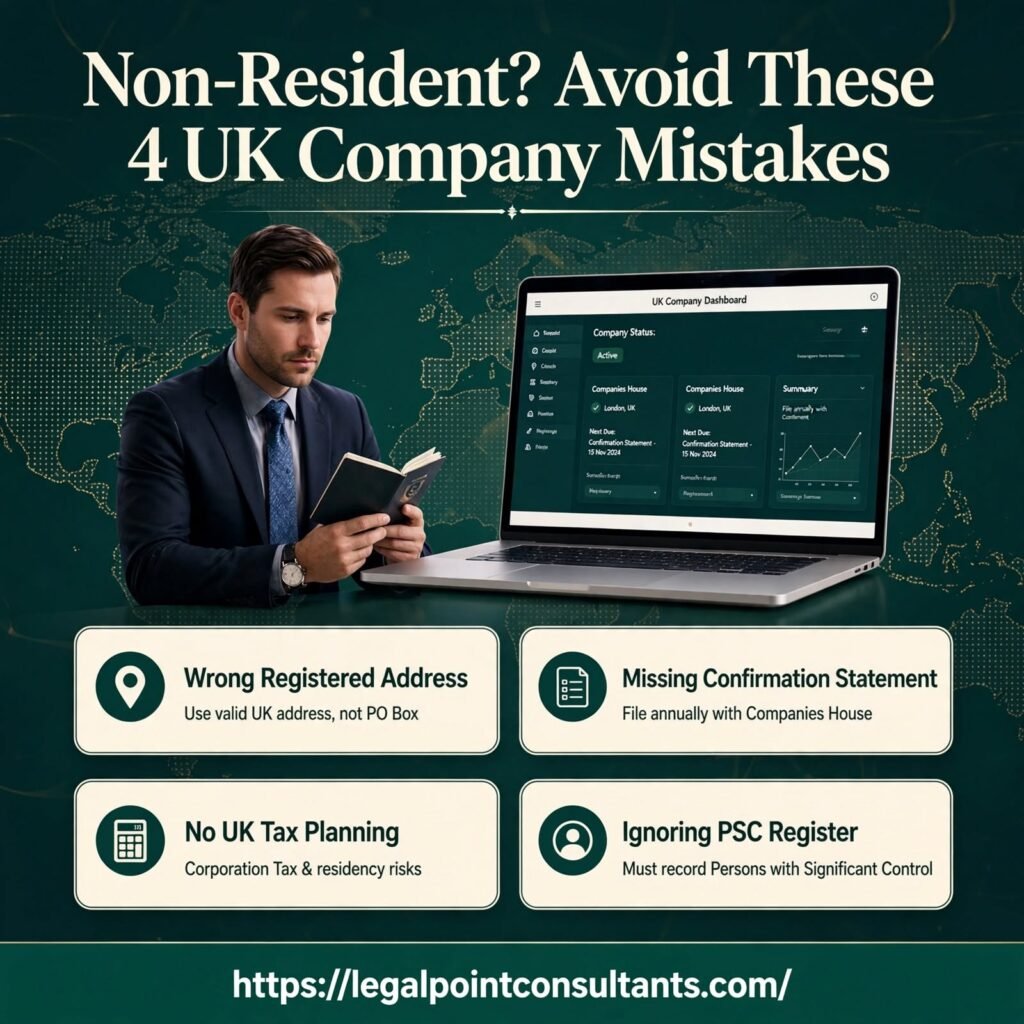
Owning a UK company while living outside the United Kingdom can be an attractive option for international entrepreneurs, consultants, technology founders and online businesses. A UK limited company can provide a recognised corporate structure, access to international markets and a professional business presence.
However, a non-resident UK company owner still needs to understand the company’s legal, tax and reporting responsibilities.
One of the biggest misconceptions is that living outside the UK means the company has few or no UK compliance obligations. In reality, a UK company continues to have responsibilities even when its directors or shareholders live abroad.
From missing Companies House filings to misunderstanding Corporation Tax, VAT, company residence and cross-border management, small mistakes can become expensive problems.
If you are a non-resident planning to establish a UK technology or software business, you can also read our detailed guide on How to Register a Software Company in the UK.
Here are four costly mistakes every non-resident UK company owner should understand.
One of the most common mistakes made by overseas company owners is assuming that compliance only matters when the company is actively trading.
That is not correct.
A UK company generally continues to have filing obligations even when it is dormant or not currently generating revenue. Companies House states that companies must file a confirmation statement at least once every year, including companies that are dormant or not trading.
Directors also have responsibilities relating to company records, annual accounts, changes to company information and other statutory matters.
Ignoring these responsibilities because you live abroad can lead to penalties and, in serious circumstances, problems with the company’s status at Companies House.
For most private limited companies, annual accounts must be filed with Companies House within nine months after the company’s financial year ends. The first accounts have a different deadline, generally up to 21 months from incorporation.
Therefore, non-resident founders should create a compliance calendar immediately after incorporation.
This is potentially one of the most expensive misunderstandings.
Your personal residence and your company’s tax position are not automatically the same thing.
A non-resident individual can own a UK company, but the company can still have UK tax obligations depending on its activities, residence, management and connection with the UK.
For example, UK-resident companies are generally subject to Corporation Tax on their chargeable profits, while non-UK resident companies can become subject to UK Corporation Tax in circumstances such as carrying on a UK trade through a permanent establishment.
This means that simply saying:
“I live outside the UK, so my UK company does not have UK tax responsibilities.”
can be a dangerous assumption.
Company residence can involve questions about where the company is centrally managed and controlled and, where relevant, the application of a double-taxation agreement.
For non-resident entrepreneurs, this becomes particularly important when the business is operated from another country.
You should consider:
This is why international company owners should assess their UK company tax position before moving money between countries or deciding how the business will be managed.
Another costly mistake is treating company incorporation as the end of the process.
It is actually the beginning.
After incorporation, a company may have ongoing tax and reporting responsibilities depending on its activities.
For example, a company that receives a notice to deliver a Company Tax Return generally has to file it even if the company has made a loss or has no Corporation Tax to pay.
For most companies, Corporation Tax is normally due nine months and one day after the end of the accounting period, while the Company Tax Return is generally due 12 months after the end of that accounting period.
VAT is another area where non-resident business owners need to be careful.
For UK-established businesses, the standard VAT registration threshold is currently £90,000 of taxable turnover.
However, VAT rules can become more complicated for businesses that are not UK-established or that provide services or sell goods across borders.
For example, different rules can apply to:
Therefore, don’t determine your VAT position simply by looking at your company’s total global revenue.
The location of your business, customers, supplies and establishment can all matter.
A non-resident founder should maintain a calendar covering:
| Compliance Area | What to Monitor |
|---|---|
| Companies House | Confirmation statement |
| Annual Accounts | Filing deadline |
| HMRC | Corporation Tax |
| Company Tax Return | Filing deadline |
| VAT | Registration and VAT returns if applicable |
| PAYE | Payroll obligations if applicable |
| PSC/Directors | Changes and identity requirements |
| Registered Office | Official company correspondence |
| Accounting Records | Accurate bookkeeping and supporting documents |
The exact obligations depend on your company’s circumstances, so professional advice should be obtained where the business operates across multiple jurisdictions.
This is perhaps the most overlooked issue for international founders.
A UK company may be incorporated in Britain while the founder lives in Pakistan, the UAE, Saudi Arabia, the United States, Canada or another country.
That does not mean the international side of the structure can be ignored.
If important business decisions are consistently made outside the UK, the founder should consider whether the management and control arrangements could create tax or legal consequences in another jurisdiction.
For example, the country where you personally live may have its own rules regarding:
The UK side is only one part of the picture.
Another common misconception is believing that owning a UK company automatically gives the founder the right to live or work in the UK.
It does not.
Company incorporation and immigration status are separate issues.
A non-resident can potentially own or direct a UK company without becoming a UK resident, but anyone planning to relocate to the UK or personally work there should separately assess the applicable immigration requirements.
This distinction is especially important for international entrepreneurs who establish a company first and later decide to move to the UK.
The real cost of these mistakes is not always the initial penalty.
The bigger problem can be the chain reaction.
For example:
Missed filing → penalty → unresolved company records → tax/accounting problems → banking difficulties → additional professional costs
Similarly:
Poor cross-border structure → incorrect tax treatment → late correction → penalties/advisory costs → restructuring
For an international entrepreneur, fixing a problem after it has developed can be significantly more expensive than setting up the structure correctly from the beginning.
A practical compliance strategy should start immediately after incorporation.
Keep records of:
Do not wait for a reminder before checking your filing deadlines.
Confirmation statements and annual accounts should be treated as recurring business responsibilities.
Company funds should not be treated as the founder’s personal bank account.
Maintain proper records for:
This becomes even more important when the owner lives in another country.
International businesses can change quickly.
A company that started as a small consulting business may later:
Each major change can potentially affect the company’s compliance position.
Before moving your business, changing ownership, adding an overseas company, relocating management, opening a new branch or distributing significant profits, review the potential legal and tax consequences.
Running a UK company from another country creates an additional layer of complexity.
The founder may have to coordinate:
Companies House + HMRC + Accounting + Banking + Cross-Border Tax + Local Country Rules
A professional corporate consultancy can help identify the compliance requirements that apply to the company’s specific structure.
Legal Point Consultants provides international corporate, tax and compliance support for entrepreneurs, startups and businesses operating across jurisdictions.
Our UK-related services include:
If you are also considering establishing a technology business, our guide on How to Register a Software Company in the UK explains the formation process, directors, shareholders, PSC requirements, SIC codes, registered office and ongoing compliance considerations.
For entrepreneurs comparing international jurisdictions, our guide on Can a Foreigner Start a Company in Dubai Without UAE Residency? can also help you understand how UAE company ownership and residency are treated separately.
Before operating your UK company from overseas, review the following:
Yes. A person does not generally need to be UK-resident simply to own a UK company. However, company formation, taxation, management and immigration are separate issues that should be considered individually.
It depends on the circumstances. The company’s tax position can depend on factors including UK residence, UK trading activities, permanent establishment, UK property and other connections. A non-resident owner should not assume that living overseas automatically removes UK tax obligations.
Generally, yes. UK companies have ongoing filing obligations, including annual accounts, although the exact accounts and filing requirements depend on the company’s circumstances.
A company generally needs to file a confirmation statement at least once every 12 months, even if there have been no changes.
Late filing can result in financial penalties, and persistent non-compliance can create more serious consequences for the company’s status.
No. Company ownership does not automatically provide UK immigration status or the right to live and work in the UK.
Not necessarily. VAT registration depends on the applicable VAT rules and the company’s circumstances. For UK-established businesses, the standard taxable turnover threshold is currently £90,000, but special rules can apply to non-established businesses and certain cross-border supplies.
It may be possible, but international management can create additional tax, corporate and regulatory considerations. The country where you live and manage the business may have its own rules affecting the company and your personal tax position.
A UK company can be a useful structure for international entrepreneurs, but being a non-resident does not mean you can ignore UK company compliance.
The four mistakes to avoid are:
The safest approach is to understand your obligations before problems arise.
Whether you already own a UK Ltd or are planning to establish one from overseas, proper company formation, tax planning, accounting and ongoing compliance can help protect your business and reduce unnecessary costs.
Legal Point Consultants helps international entrepreneurs with UK company formation, Companies House compliance, HMRC-related requirements, Corporation Tax, VAT, accounting and ongoing corporate support.
Phone: +92 333 7703712
Email: legalpointteam@gmail.com
Global Business Solutions. Local Expertise. Trusted Worldwide.
 Company Formation
Can a Foreigner Start a Company in Dubai Without UAE Residency? Yes, a foreigner can generally establish and own a company in Dubai without…
Read more Company Formation
Setting up a company in Dubai puts you in one of the world's most business-friendly cities — no personal income tax, 100% foreign ownership…
Read more Company Formation
Non-resident foreign investors can establish and own a company in Saudi Arabia without necessarily being Saudi residents. However, the process depends on the business…
Read more