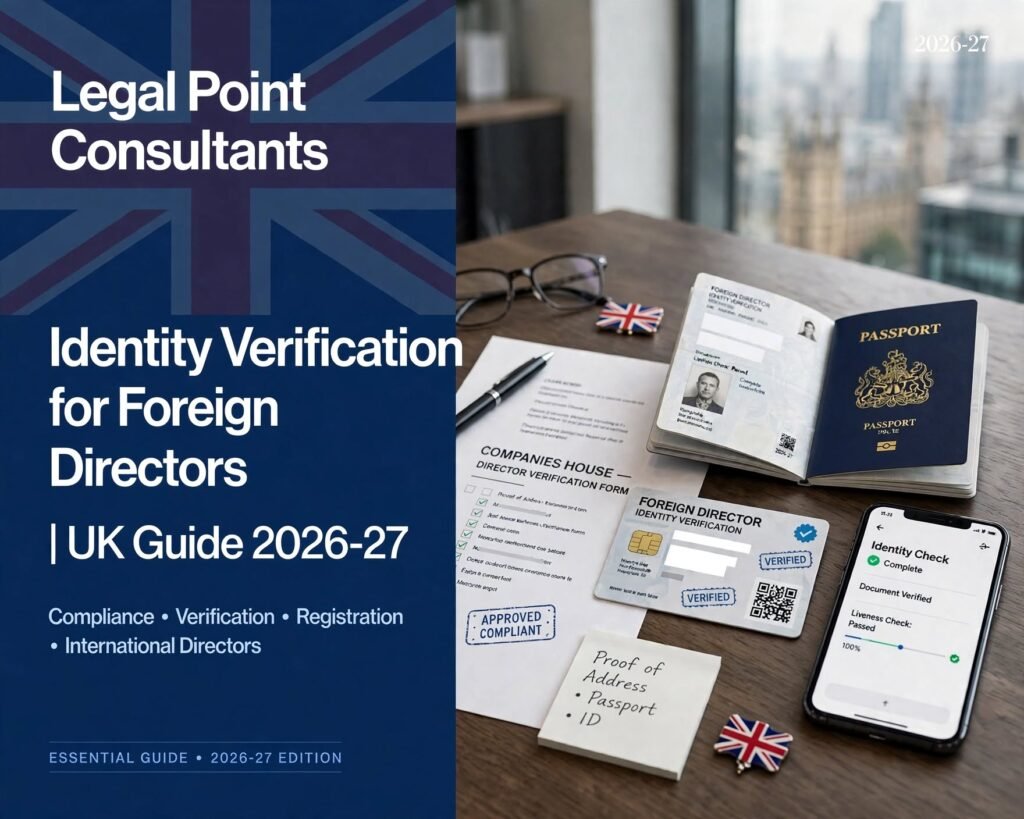
Companies House identity verification for foreign directors is now an important part of UK company compliance. Since identity verification became a legal requirement, directors and other relevant individuals must prove who they are and connect their verified identity with their Companies House records. This applies even when a director lives outside the United Kingdom.
For international entrepreneurs, this means that forming or managing a UK company is no longer simply about submitting incorporation documents. A foreign director may also need to complete identity verification, obtain a Companies House personal code and provide that code as part of the relevant company filing.
The good news is that you do not generally need to live in the UK to become a director of a UK company. UK company formation is generally available to non-UK residents, and identity verification can be completed remotely in appropriate circumstances. Legal Point Consultants supports overseas founders with UK company formation, Companies House filings, HMRC registration and ongoing compliance.
This guide explains what foreign directors need to know about the new Companies House identity verification requirements, including the available verification routes, documents, personal codes, deadlines and common mistakes.
What Is Companies House Identity Verification?
Companies House identity verification is a legal process designed to confirm that an individual is genuinely the person they claim to be.
The purpose is to improve the reliability of the UK company register and reduce the risk of companies being used for fraud, money laundering and other unlawful activities.
Under the current rules, identity verification applies to several categories of individuals, including:
Directors
Equivalent roles such as certain members, general partners and managing officers
People with Significant Control (PSCs)
Authorised Corporate Service Providers (ACSPs)
Identity verification is normally completed once. After successful verification, the individual receives a unique Companies House personal code. This code is then used to connect the verified identity with the person’s company roles.
For foreign directors, the key point is simple:
Being based outside the UK does not automatically exempt a director from Companies House identity verification.
Does a Foreign Director Have to Verify Their Identity?
Yes.
A foreign or non-resident individual serving as a director of a UK company is generally subject to the same identity-verification requirement as a UK-resident director.
Companies House specifically states that directors must verify their identity. For a newly incorporated UK company, the personal code for each director is required as part of the registration process. Existing directors must provide their personal code as part of the relevant confirmation statement process.
This means a director living in countries such as:
Pakistan
United Arab Emirates
Saudi Arabia
United States
Canada
India
Australia
Qatar
Oman
Bahrain
may still need to complete Companies House identity verification if they are acting as a director of a UK company.
The director’s country of residence does not by itself remove the requirement.
Can a Non-UK Resident Become a UK Company Director?
Yes.
A person does not generally have to be a UK resident to become a director of a UK company. Legal Point Consultants also provides UK company formation support for overseas founders and non-resident business owners.
However, being eligible to become a director and completing identity verification are separate matters.
A foreign founder may need to deal with:
UK company incorporation
Director appointment
Companies House identity verification
Personal code
Registered office requirements
PSC information
Confirmation statement
Annual accounts
Corporation Tax and other HMRC obligations where applicable
Therefore, overseas entrepreneurs should treat identity verification as part of their overall UK company compliance process rather than as an isolated formality.
How Can a Foreign Director Verify Their Identity?
There are currently two main routes relevant to foreign directors:
1. GOV.UK One Login
2. Authorised Corporate Service Provider (ACSP)
Companies House confirms that an individual can use an ACSP from any country, provided the agent is properly authorised and meets the required AML supervision requirements.
The most suitable route depends on the individual’s identification documents and circumstances.
Option 1: Verify Through GOV.UK One Login
Foreign directors who have suitable identification documents may be able to verify their identity through GOV.UK One Login.
One of the important options for overseas individuals is a biometric passport.
Companies House states that the online verification route can accept a biometric passport from any country, subject to the applicable verification process.
The GOV.UK One Login process may involve:
Providing personal information
Providing information about the identity document
Scanning the document
Completing a facial/liveness check
Matching the individual to the identity document
Completing additional questions where required
The GOV.UK One Login app route supports a non-UK passport with a biometric chip. The passport must be the original document rather than a photocopy or digital copy.
What Is a Biometric Passport?
A biometric passport contains an electronic chip that stores information used to verify the passport holder’s identity.
You can normally identify a biometric passport by looking for the international biometric symbol on the passport cover.
For foreign directors, having a biometric passport can make the remote verification process significantly more straightforward.
Option 2: Use an Authorised Corporate Service Provider
If a foreign director cannot complete the online verification process or does not have the required identification for GOV.UK One Login, they may use an Authorised Corporate Service Provider, commonly called an ACSP.
An ACSP can include certain accountants, solicitors and company formation professionals that are registered with Companies House and supervised for Anti-Money Laundering purposes.
Importantly for overseas directors, Companies House confirms that identity verification through an ACSP can be completed from any country.
The ACSP will normally require evidence such as:
Full legal name
Home address
Email address
Approved identity evidence
Additional information where necessary to satisfy verification requirements
The exact evidence required can depend on the verification route and the individual’s circumstances.
After successful verification, Companies House sends the personal code to the email address provided by the ACSP.
What Documents Does a Foreign Director Need?
The documents depend on the verification route.
For the GOV.UK One Login app, an overseas director may use a non-UK biometric passport. Other accepted documents are available depending on the individual’s circumstances and verification route.
For ACSP verification, the agent will explain which identity evidence is acceptable under the applicable Companies House requirements.
Foreign directors should generally make sure that:
Their name is consistent across documents
Their date of birth is accurate
Their identity document is valid
Their photograph is clear
Their residential information is accurate
Their Companies House information matches their identity details
A mismatch between the information supplied to Companies House and the information connected to the personal code can cause problems when trying to connect the verified identity to a company role.
What Is the Companies House Personal Code?
After successful identity verification, Companies House issues an 11-character personal code.
This code belongs to the individual, not the company.
For example, if a foreign entrepreneur is a director of three UK companies, the person does not normally need three separate identity checks. The same personal code can be used to confirm the individual’s verified identity for each relevant company role.
The personal code is therefore an important part of a foreign director’s UK corporate compliance records.
Keep Your Personal Code Secure
A personal code should be treated as confidential information.
You may need to share it with:
Your accountant
Company formation agent
Corporate compliance provider
Other authorised professionals filing on your behalf
However, you should only share it with people or organisations you trust.
When Does a Foreign Director Need to Provide the Personal Code?
The timing depends on whether the company is new or already exists.
For a New UK Company
When registering a new company, the personal code for each director must be provided as part of the relevant registration process.
This makes identity verification an important step in the incorporation process.
For overseas founders planning to establish a UK limited company, it is therefore sensible to complete the identity verification process early rather than leaving it until the final stage.
For an Existing UK Company
Existing directors will generally need to provide their personal code with the company’s next confirmation statement.
If a director has appointments in more than one company, the verification information must be connected to each relevant role.
The exact deadline depends on the company’s filing circumstances.
What About Foreign Directors of Overseas Companies Registered in the UK?
This is an important distinction.
A UK limited company and an overseas company with a UK establishment are not the same thing.
Companies House also requires directors of overseas companies registered in the UK to verify their identity.
For an overseas company, all directors must complete identity verification and obtain their Companies House personal codes. The company must then provide the relevant verification information using the applicable Companies House process.
For example, if a Pakistani company establishes a UK presence and registers as an overseas company with Companies House, its directors may have separate identity-verification obligations.
For an overseas company, Companies House guidance states that the relevant identity verification information must be provided by the anniversary of the date the UK establishment was opened.
This is different from the process for a standard UK-incorporated private limited company.
Companies House Identity Verification for Pakistani Directors
For Pakistani entrepreneurs, the new rules are particularly relevant when establishing a UK business remotely.
A Pakistani founder may be able to verify identity remotely where the required verification route and documents are available.
For example, a Pakistani director with a suitable biometric passport may be able to use the GOV.UK One Login route.
Where the online route is not suitable, an authorised agent may provide another route for identity verification.
The important point is that a Pakistani director does not automatically need to travel to the UK simply because Companies House requires identity verification.
Companies House expressly allows identity verification through an ACSP from any country.
This can make UK company formation more practical for Pakistani founders, investors and international business owners.
Step-by-Step: Companies House Identity Verification for a Foreign Director
The process can be understood in the following steps.
Step 1: Confirm Your Company Role
Determine whether you are:
A director
A PSC
A director of an overseas company
Another role covered by the current Companies House requirements
The obligations can differ depending on the role.
Step 2: Check Your Identification
Determine whether you have suitable identification for the GOV.UK One Login process.
A biometric passport can be particularly useful for overseas directors.
Step 3: Choose Your Verification Route
You can consider:
GOV.UK One Login or Authorised Corporate Service Provider
If you cannot use the online route, an ACSP may be appropriate.
Step 4: Complete Identity Verification
Provide the required personal information and identity evidence.
The information must relate to you personally, not to your company. Companies House specifically warns that the verification questions are about the individual.
Step 5: Receive Your Personal Code
Once verification is successful, Companies House provides your unique personal code.
Step 6: Connect Your Identity to Your Company Role
The personal code must then be provided to Companies House as required for your director or PSC role.
Step 7: Maintain Ongoing Compliance
Identity verification is only one part of UK corporate compliance.
Your company may also need to keep up with:
Confirmation statements
Annual accounts
Corporation Tax
VAT, where applicable
PAYE, where applicable
PSC information
Registered office information
Director information
Changes to company structure
What Happens If a Foreign Director Does Not Verify?
Ignoring identity verification is not simply an administrative inconvenience.
Companies House states that continuing to act as a director without completing the required identity verification can constitute an offence. Companies and directors may also face enforcement action for non-compliance.
Possible consequences can include:
Financial penalties
Enforcement action
Criminal prosecution in appropriate cases
Restrictions on certain company activities
Public register annotations
Problems appointing new directors
Problems registering a new company
Companies House has stated that it can use a range of enforcement measures where individuals and companies fail to comply.
For an overseas entrepreneur, this makes timely verification particularly important because international company owners may otherwise discover compliance problems when trying to complete annual filings or make corporate changes.
Common Problems Foreign Directors Face
1. Assuming Non-Residence Means Exemption
One of the most common misunderstandings is that a person living outside the UK does not need to complete identity verification.
That is incorrect.
The requirement is connected to the person’s role, not simply their place of residence.
2. Using an Incompatible Passport
Not every passport will necessarily work through every online verification route.
The GOV.UK One Login app specifically supports biometric passports from outside the UK.
If your identification does not work through the online route, an ACSP may be an alternative.
3. Information Does Not Match
A mismatch in:
Name
Date of birth
Personal details
Companies House records
can prevent the verified identity from being properly connected to the company.
Companies House provides specific guidance for situations where personal details linked to the code do not match its records.
4. Losing the Personal Code
The personal code may be needed for future filings.
If you verify through an ACSP, Companies House sends the code to the email address supplied by the agent. The code can also be saved to a Companies House account.
Foreign directors should store the code securely.
5. Treating Identity Verification as the Entire Compliance Process
Completing identity verification does not mean that a UK company is fully compliant.
A company can still have outstanding:
Tax filings
Annual accounts
Confirmation statements
PSC updates
VAT obligations
Payroll obligations
Other statutory requirements
Identity verification should therefore be viewed as one component of the wider corporate compliance framework.
Does Identity Verification Make Foreign Directors’ Information Public?
The identity verification process involves providing personal information to Companies House, but supporting identity evidence is not simply published as part of the public register.
Companies House states that supporting information supplied for identity verification is not made available to the public through its services.
After identity verification, however, a verification statement may appear on the public register when the verified identity is connected to a relevant role. The statement can include the individual’s name, verification date and information about the ACSP that completed the verification.
This distinction is important for overseas directors who are concerned about privacy.
Foreign Director Identity Verification vs UK Company Formation
Identity verification should be planned alongside company formation rather than after it.
For an overseas founder, a typical UK setup may involve:
Business planning → Company name → Director/PSC details → Identity verification → Companies House incorporation → HMRC registration → Business banking → Accounting → Annual compliance
The exact process varies according to the company’s activities, ownership structure, tax position and the founder’s circumstances.
Legal Point Consultants provides UK company formation and ongoing compliance support for overseas founders, including Companies House incorporation, HMRC registration, annual accounts and confirmation statements.
How Legal Point Consultants Can Help Foreign Directors
For overseas entrepreneurs, dealing with UK company compliance from another country can be confusing, particularly when Companies House requirements change.
Legal Point Consultants can assist with the wider UK corporate setup, including:
UK limited company formation
Non-resident company setup
Companies House filings
Director and PSC compliance
HMRC registration
Corporation Tax support
VAT registration
Annual accounts
Confirmation statements
Ongoing corporate compliance
Accounting and bookkeeping
The firm’s UK service offering is designed for overseas founders who want to establish and maintain a UK business remotely.
If you are a Pakistani, UAE, Saudi, US, Canadian or other international entrepreneur planning to operate a UK company, getting the identity-verification and incorporation process right from the beginning can help avoid unnecessary compliance problems later.
Frequently Asked Questions
Do foreign directors have to verify their identity with Companies House?
Yes. Directors are required to verify their identity under the current Companies House rules, regardless of whether they are UK residents or based overseas.
Can a Pakistani citizen become a director of a UK company?
Generally, yes. UK company formation is available to non-UK residents, subject to the applicable company-law and compliance requirements. A Pakistani director must also satisfy the applicable Companies House identity-verification requirements.
Can a foreign director verify their identity without travelling to the UK?
Yes, in many circumstances. A suitable foreign biometric passport may allow online verification through GOV.UK One Login. Alternatively, an authorised corporate service provider can verify an individual’s identity from any country.
What is a Companies House personal code?
A Companies House personal code is a unique 11-character code issued after successful identity verification. It belongs to the individual rather than the company.
Is identity verification required for PSCs?
Yes. People with Significant Control must also verify their identity and provide their personal code according to the applicable timetable.
Can one personal code be used for multiple UK companies?
Yes. Identity verification is normally completed once, and the same personal code can be used to confirm the individual’s verified identity for multiple company appointments.
What happens if a foreign director refuses to verify?
Continuing to act as a director without completing the required verification can constitute an offence. Companies House may use financial penalties and other enforcement measures where requirements are not met.
Can an ACSP verify a foreign director?
Yes. An Authorised Corporate Service Provider can verify an individual’s identity on their behalf, and Companies House states that this can be done from any country.
Is a biometric passport required for every foreign director?
Not necessarily. A biometric passport is one important route for online verification, but alternative verification methods may be available depending on the person’s circumstances. An ACSP can also provide an alternative verification route.
Does identity verification replace annual UK company compliance?
No. Identity verification is only one compliance requirement. UK companies may also have Companies House and HMRC filing obligations, including accounts, confirmation statements and applicable tax filings.
Final Thoughts
Companies House identity verification for foreign directors is now a fundamental part of UK corporate compliance.
For overseas founders, the requirement does not mean that they must relocate to the UK. Depending on their documents and circumstances, they may be able to verify remotely through GOV.UK One Login or use an Authorised Corporate Service Provider from their country of residence.
The most important steps are to verify your identity on time, keep your Companies House personal code secure, ensure your personal information matches your company records and continue meeting the company’s wider statutory and tax obligations.
If you are planning to establish a UK company from Pakistan, UAE, Saudi Arabia or another country, professional assistance can help coordinate incorporation, identity verification and ongoing compliance.
Legal Point Consultants — Global Business Solutions. Local Expertise. Trusted Worldwide.
Get professional assistance with UK company formation and corporate compliance.