UK Ltd vs LLP for Non-Resident Founders: Which Business Structure Should You Choose?
UK Ltd vs LLP for Non-Resident Founders is an important consideration for international entrepreneurs planning to establish a business in the United Kingdom. Both structures can offer limited liability and a separate legal identity, but they differ significantly in taxation, ownership, management, compliance, and how profits are distributed. Understanding these differences helps overseas founders select a structure that fits their business activities, investment plans, and long-term goals.
The United Kingdom allows eligible non-residents to establish and own UK businesses without necessarily becoming UK residents. However, registering a company does not automatically provide immigration rights, tax exemption, a UK bank account, or permission to live and work in the country.
For international entrepreneurs, the decision between a private limited company (Ltd) and a limited liability partnership (LLP) should be based on the business model, the founders’ tax residence, the location of customers and management, and the way profits will be earned and withdrawn.
This guide explains the legal, financial, and practical differences between the two structures, including the registration process and ongoing obligations.
1. What Is a UK Limited Company (Ltd)?
A UK private limited company is a separate legal entity registered with Companies House under the Companies Act 2006. It can enter into contracts, own assets, employ staff, open business accounts subject to provider approval, and conduct commercial activities in its own name.
The company is owned by shareholders and managed by directors. A single individual can generally be the sole shareholder and director, provided the legal requirements are met.
For non-resident founders, a private company limited by shares is a common structure for operating a software business, e-commerce company, consultancy, digital agency, or international trading business.
Key characteristics of a UK Ltd
Separate legal personality from its shareholders.
Shareholders’ liability is generally limited to any amount unpaid on their shares.
At least one director is required, and the director must be at least 16.
Directors do not have to reside in the UK.
The company must maintain an appropriate UK registered office address in its jurisdiction of registration.
The company is generally subject to UK Corporation Tax on its taxable profits, subject to the applicable tax rules.
Companies House confirms that directors can live outside the UK, while a UK registered office remains mandatory.
How does a UK Ltd work for overseas owners?
Suppose a software developer living in Pakistan establishes a UK private limited company to provide software development services to clients in the UK and other countries.
The founder owns shares in the company and may act as its director. The company enters into contracts with customers, receives business revenue, pays its operating expenses, and accounts for its taxable profits.
The founder’s personal income and the company’s profits are legally distinct. Money belonging to the company does not automatically become the shareholder’s personal money. Payments to the owner must be properly classified, for example as salary, dividends, reimbursement of legitimate expenses, or another legally supported transaction.
This distinction is important for international founders because personal taxation may also arise in their country of residence.
2. What Is a UK Limited Liability Partnership (LLP)?
A UK LLP is a separate legal entity formed under the Limited Liability Partnerships Act 2000. It combines certain features of a traditional partnership with the separate legal personality and limited liability characteristics of a corporate entity.
An LLP has members rather than shareholders. Members participate in the business according to the LLP agreement, which sets out their rights, responsibilities, profit-sharing arrangements, and management rules.
According to HMRC, an LLP can be formed by two or more persons carrying on a partnership-type business and must be registered with Companies House.
Key characteristics of a UK LLP
Requires at least two members to form and maintain the required membership.
Members can be individuals or qualifying legal entities.
Has a separate legal identity from its members.
Offers limited liability, subject to applicable law and personal guarantees or individual misconduct.
Usually treated as tax-transparent for UK tax purposes when carrying on a business with a view to profit.
Operates according to its LLP agreement and applicable statutory requirements.
How does an LLP work for foreign founders?
Consider two overseas consultants who want to operate a joint consulting business in the UK.
They establish an LLP, agree on their respective contributions and profit-sharing percentages, and register the entity with Companies House. The LLP enters into contracts with clients and earns business income.
Under the normal UK tax-transparent treatment, the members are generally taxed on their respective shares of taxable profits rather than the LLP paying Corporation Tax on those trading profits as a company would.
However, the tax outcome for non-resident members depends on the source and nature of the profits, their tax residence, applicable treaties, and whether the business creates a UK taxable presence.
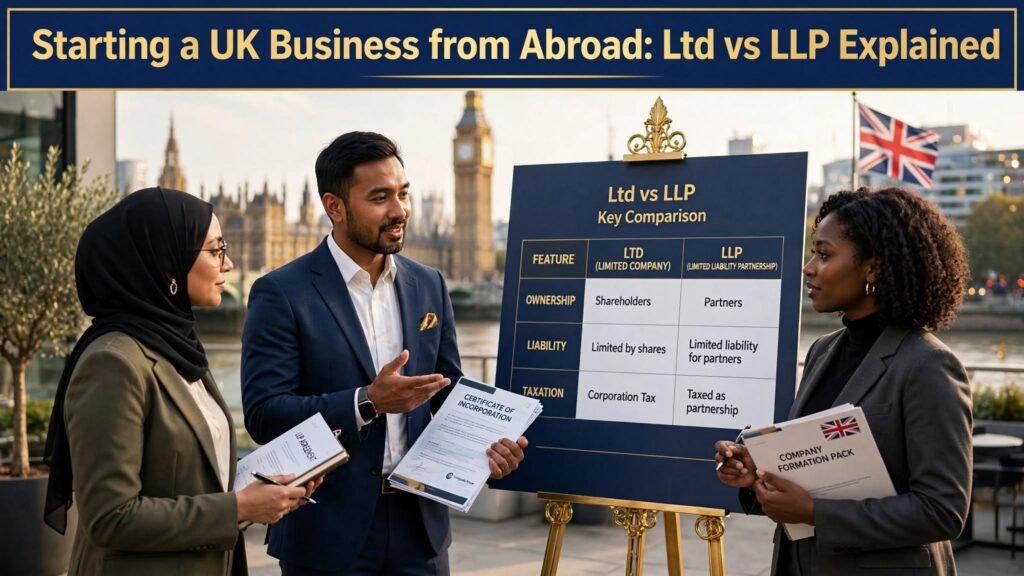
3. UK Ltd vs LLP for Non-Resident Founders: Key Differences
The main distinction is that a UK Ltd is generally taxed as a company, whereas a UK LLP carrying on a business for profit is normally treated as a partnership for tax purposes.
The following table summarises the principal differences.
Feature
UK Ltd
UK LLP
Legal structure
Separate company
Separate body corporate
Owners
Shareholders
Members
Minimum owners
One shareholder
Two members
Management
Directors
Members, as agreed
Liability
Generally limited to unpaid share capital
Generally limited, subject to exceptions
Profit taxation
Corporation Tax at company level
Generally taxed on members’ allocated profits
Profit distribution
Salary, dividends, or other lawful payments
Allocations and payments under LLP agreement and tax rules
Share ownership
Shares can be transferred subject to company rules
Membership changes follow LLP agreement and legal requirements
Professional practices, joint ventures, collaborative services
These are general structural differences. An LLP can be treated as a body corporate under general law but as a partnership for most UK tax purposes.
4. Can Non-UK Residents Own a UK Ltd or LLP?
Yes, subject to applicable legal restrictions, sanctions, identity verification, and the requirements of the relevant registration process.
A person does not ordinarily need to be a British citizen or UK resident simply to become a shareholder or director of a UK private limited company. Overseas individuals and qualifying overseas entities can also participate in LLPs.
However, founders should distinguish between three separate questions:
Can a non-resident legally own or form the business?
Can that business operate in the UK and meet its regulatory requirements?
Can the owner personally live or work in the UK?
Company or LLP registration addresses the first question. It does not automatically resolve the other two.
UK residency and registered office requirements
A UK Ltd must have an appropriate registered office address in the same UK jurisdiction where it is registered. For example, a company registered in Scotland must have its registered office in Scotland.
The address must be capable of receiving official communications and meeting the applicable delivery and acknowledgement requirements. A simple PO Box is not sufficient.
An LLP also needs a registered office in the appropriate UK jurisdiction. Overseas founders often use a legitimate professional registered-office service, subject to the provider’s terms and legal requirements.
A registered office is not proof that the founder lives in the UK, nor does it necessarily establish that the business is actually managed or operated there.
Director and member eligibility
For a UK Ltd, at least one director is required. A private company does not generally need a company secretary. Directors must meet legal eligibility requirements, including restrictions relating to disqualification and certain bankruptcy circumstances.
For an LLP, at least two members are required. Members may have different management and financial rights under the LLP agreement, but they must comply with applicable statutory and filing responsibilities.
Non-resident founders should also expect identity and anti-money-laundering checks from formation agents, accountants, banks, and other service providers where applicable.
5. Taxation: UK Ltd vs LLP for Non-Resident Founders
Taxation is often the most important consideration for an overseas entrepreneur. The choice of structure affects when tax arises, who pays it, and how money can be transferred to the owners.
Neither structure should be selected on the assumption that non-resident ownership automatically makes UK business income tax-free.
A. Corporation Tax for a UK Ltd
A UK Ltd is generally liable to UK Corporation Tax on its taxable profits. The applicable rate depends on the company’s profits and relevant rules, including thresholds, associated companies, and any available reliefs.
For the 2026 tax year, the general Corporation Tax rates are:
Taxable profits
General rate
£50,000 or less
19% small profits rate, subject to eligibility
Over £250,000
25% main rate
Between £50,000 and £250,000
Marginal relief may apply
These thresholds can be reduced in certain circumstances, including where a company has associated companies or a short accounting period. The applicable rules should be checked with HMRC or a UK tax adviser before calculating a company’s actual liability.
The company normally deducts allowable business expenses when calculating taxable profits, subject to tax rules.
For example, a UK Ltd generating revenue from software development may have deductible business expenses such as eligible software subscriptions, professional fees, employee costs, and other qualifying operating expenses.
The company’s taxable profit is not necessarily the same as its gross revenue or its cash balance.
B. How are dividends taxed for non-resident shareholders?
A UK Ltd may distribute profits to shareholders as dividends, provided the company has sufficient distributable profits and follows the applicable company-law procedures.
A dividend is a distribution of company profits, not a business expense deductible against Corporation Tax.
For a shareholder living outside the UK, the UK tax treatment of dividends depends on the applicable rules and circumstances. The shareholder’s country of tax residence may impose its own tax on the dividend, subject to any available foreign tax credit or treaty relief.
The founder should therefore consider both the company’s Corporation Tax and their own personal tax position before deciding how to extract profits.
A salary paid to a director may also involve payroll, employment tax, social security, and cross-border obligations depending on where the director works and the relevant arrangements.
C. LLP taxation for non-resident members
A UK LLP carrying on a business with a view to profit is normally tax-transparent under the UK rules. This means the members are generally taxed on their respective shares of taxable profits rather than the LLP paying Corporation Tax on those trading profits.
HMRC explains that members are normally taxed on their allocated profits under the rules applicable to partnerships.
For non-resident individuals, UK tax liability generally depends on the source of the profits and the applicable tax legislation.
HMRC guidance states that non-resident individual partners are generally liable to UK tax on their share of UK profits, rather than automatically on all worldwide partnership profits.
This is a crucial distinction. The fact that a member lives abroad does not itself mean that the member’s share of UK-source business profits is exempt from UK tax.
D. Tax implications in the founder’s home country
An overseas founder may have tax responsibilities in both the UK and their country of residence.
For example, a founder living in Pakistan who owns a UK business should examine:
The founder’s personal tax residence under the applicable domestic rules.
The taxation of foreign dividends, salary, partnership income, or other receipts.
Whether foreign tax credit relief or a double taxation agreement applies.
Foreign exchange, reporting, and remittance requirements.
Whether management activities performed from the home country create a taxable presence or other local obligations.
A double taxation agreement does not automatically eliminate all tax liabilities. Its application depends on the relevant treaty, the nature of the income, and the individual’s or entity’s circumstances.
Practical point: Obtain cross-border tax advice before choosing an LLP purely for tax transparency. A structure that is transparent in the UK may be treated differently in the founder’s country of residence, potentially creating mismatches or additional reporting.
6. Limited Liability: Which Structure Protects Founders?
Both UK Ltd and LLP structures can provide limited liability, but neither should be treated as complete personal protection against every business risk.
Liability in a UK Ltd
Shareholders are generally liable only up to any unpaid amount on their shares. If a shareholder has fully paid for their shares, they ordinarily do not become personally responsible for the company’s debts merely because they own the company.
However, personal liability can arise in situations involving personal guarantees, fraud, certain director breaches, unlawful conduct, or other circumstances established by law.
Directors have legal duties and must act within the applicable statutory and fiduciary framework.
Liability in a UK LLP
An LLP is a separate legal entity, and members generally benefit from limited liability for the LLP’s obligations.
However, personal guarantees, personal wrongdoing, professional negligence, or specific statutory liabilities can expose a member to personal claims.
For professional service businesses, appropriate professional indemnity insurance and a carefully drafted LLP agreement are important risk-management measures.
7. UK Ltd vs LLP: Registration Process for Overseas Founders
Both structures are registered with Companies House, but their formation documents and ownership records differ.
How to register a UK Ltd
Choose a company name. Check that the proposed name complies with Companies House naming requirements and does not improperly use restricted terms or infringe existing rights.
Choose the registered office jurisdiction. Decide whether the company will be registered in England and Wales, Wales, Scotland, or Northern Ireland and obtain an appropriate address in that jurisdiction.
Appoint the director and shareholder. Prepare the required personal details, share structure, and ownership information.
Prepare incorporation documents. This includes the memorandum, articles of association, share information, statement of capital, and required Companies House declarations.
Identify people with significant control. Provide the required information about individuals or entities who meet the applicable control or ownership criteria.
Submit the application. File the incorporation application with Companies House and pay the applicable registration fee.
Complete post-registration arrangements. Set up accounting records, assess Corporation Tax registration, establish payroll or VAT arrangements if needed, and apply for banking services.
Companies House requires information about the company’s proposed officers, registered office, business activities, and persons with significant control as part of the incorporation process.
How to register a UK LLP
Select an LLP name. Check the name against the relevant Companies House rules.
Appoint at least two members. Identify the initial members and their details.
Provide the registered office. Choose an appropriate UK address in the correct jurisdiction.
Prepare an LLP agreement. Define capital contributions, profit shares, decision-making, member duties, dispute resolution, and exit arrangements.
File the incorporation application. Submit the required formation information to Companies House.
Set up tax and accounting procedures. Determine partnership reporting responsibilities and each member’s tax position.
The LLP agreement is especially important because it governs the relationship between members. HMRC recognises that LLP members’ rights and duties are generally determined by their agreement, subject to applicable law.
An overseas founder should avoid using a generic agreement without considering profit allocation, member withdrawal, decision-making authority, capital contributions, and the treatment of disputes.
8. Annual Compliance and Reporting Requirements
Registration is only the beginning. Both structures must maintain accurate records and meet their ongoing legal and tax obligations, even if the business has limited activity.
UK Ltd compliance
A UK limited company generally needs to:
Prepare and file annual accounts with Companies House.
Submit a confirmation statement within the applicable filing period.
Maintain statutory registers and company records as required.
Keep Companies House informed about changes to directors, shareholders where relevant, persons with significant control, and registered office details.
Submit Corporation Tax returns when required and pay any tax due.
Maintain accounting records and supporting documents.
Meet VAT, payroll, employment, and other reporting requirements where applicable.
Companies House confirms that directors remain legally responsible for ensuring the company’s accounts and required filings are completed on time, even if an accountant is appointed.
A company may still have filing obligations when it is dormant. Dormancy for Corporation Tax purposes and the Companies House definition of a dormant company are separate matters.
UK LLP compliance
An LLP generally needs to:
Prepare and file annual accounts.
Submit a confirmation statement.
Maintain appropriate accounting records.
File partnership tax returns and relevant member information with HMRC.
Ensure members report their taxable shares of profits as required.
Update Companies House about changes to members and other required details.
The exact reporting obligations depend on the LLP’s activities, size, accounting period, and member circumstances.
Non-resident members should establish who will manage the LLP’s accounting records, partnership return, and individual tax reporting obligations before commencing operations.
9. UK Business Bank Account for Non-Resident Founders
Opening a business bank account is a separate process from incorporating a UK Ltd or LLP.
A certificate of incorporation or LLP registration does not guarantee approval from a bank or payment service provider. Each provider has its own eligibility criteria, due diligence procedures, supported countries, and risk policies.
What documents might be required?
Depending on the provider, a non-resident founder may be asked to supply:
Certificate of incorporation or LLP registration documents.
Company or LLP registration number.
Passport or other acceptable identity documents.
Proof of residential address.
Details of directors, shareholders, members, and beneficial owners.
Description of business activities and expected transaction volumes.
Evidence of business address, contracts, invoices, or source of funds.
Tax residency and tax identification information.
Requirements differ between providers. Some may require a UK-based director, a UK trading presence, or additional verification, while others may consider overseas-owned businesses.
Can a founder use a fintech account?
Some electronic money institutions and payment service providers offer business accounts or payment services to eligible international businesses.
However, an electronic money account is not necessarily a bank account, and the services, protections, and eligibility requirements may differ.
Before applying, founders should confirm that the provider supports the company’s country of ownership, the founder’s country of residence, and the business’s intended activities.
10. Costs of Forming and Maintaining a UK Ltd or LLP
The total cost of establishing a UK business includes more than the Companies House registration fee.
It is useful to divide expenses into three categories.
Formation costs
Companies House registration fee
The official filing fee depends on the registration method and applicable fee schedule. Verify the current fee on GOV.UK before submitting an application.
Registered office and formation agent
A professional address, company formation service, or identity verification support may involve separate charges.
Legal and accounting advice
Costs depend on the ownership structure, cross-border tax position, complexity of the business, and the professional services required.
Ongoing costs
Annual accounts, bookkeeping, tax returns, registered office renewals, payroll, VAT compliance, insurance, and any professional membership or regulatory costs.
Which structure costs less?
There is no universal answer.
An LLP may require additional legal work to establish an agreement between members and maintain partnership tax reporting. A Ltd may involve company accounts, Corporation Tax compliance, payroll, and additional procedures for distributing profits.
The overall cost depends on business turnover, transaction volume, number of owners, tax residence, and the level of professional support needed.
Non-resident founders should compare the total expected annual compliance cost, not just the initial incorporation fee.
11. Advantages and Disadvantages of Each Structure
The following comparison summarises practical considerations without assuming that either structure is suitable for every founder.
UK Ltd: advantages
Can be established with one shareholder and one director, subject to requirements.
Offers a familiar structure for commercial contracts and external investment.
Provides share-based ownership and mechanisms for issuing shares.
Separates company assets and liabilities from those of its owners.
May allow profits to be retained in the company after Corporation Tax for reinvestment.
UK Ltd: considerations
Corporation Tax and shareholder-level tax may both be relevant.
Directors have statutory responsibilities and filing obligations.
Dividends must comply with company-law requirements.
Shareholder changes, investor rights, and governance need appropriate documentation.
UK LLP: advantages
Flexible arrangements for members’ contributions, responsibilities, and profit sharing.
Separate legal personality and limited liability in general.
Normal tax-transparent treatment may suit businesses where members participate directly in the business.
Can accommodate collaborative professional services and joint ventures.
UK LLP: considerations
Requires at least two members.
Members may have UK tax liabilities on their taxable shares of UK profits even when non-resident.
A carefully drafted LLP agreement is important.
Tax reporting can be more complicated for members in different countries.
Share-based investment and ownership transfers are not structured in the same way as a company.
12. Which Structure Fits Different Types of Foreign Businesses?
The appropriate legal structure depends on how the business operates and the founders’ commercial objectives.
Business model
Relevant considerations
Software or SaaS startup
Share ownership, external investment, intellectual property, employee equity, and reinvestment of profits
E-commerce business
Supplier contracts, payment processing, product liability, VAT, and international sales
Digital marketing agency
Client contracts, employees or contractors, service delivery, and profit extraction
Professional consultancy
Number of members, professional regulations, profit-sharing arrangements, and personal tax exposure
Joint venture between consultants
Member contributions, voting rights, profit allocation, and exit arrangements
International trading company
Import/export regulations, contractual risk, VAT, customs, and the location of business operations
For a software or technology startup planning to bring in investors, share-based ownership may be relevant. For a professional practice in which two or more members jointly provide services and share profits, an LLP agreement may be central to the arrangement.
These are structural considerations, not a substitute for assessing the particular business, industry regulations, and tax position.
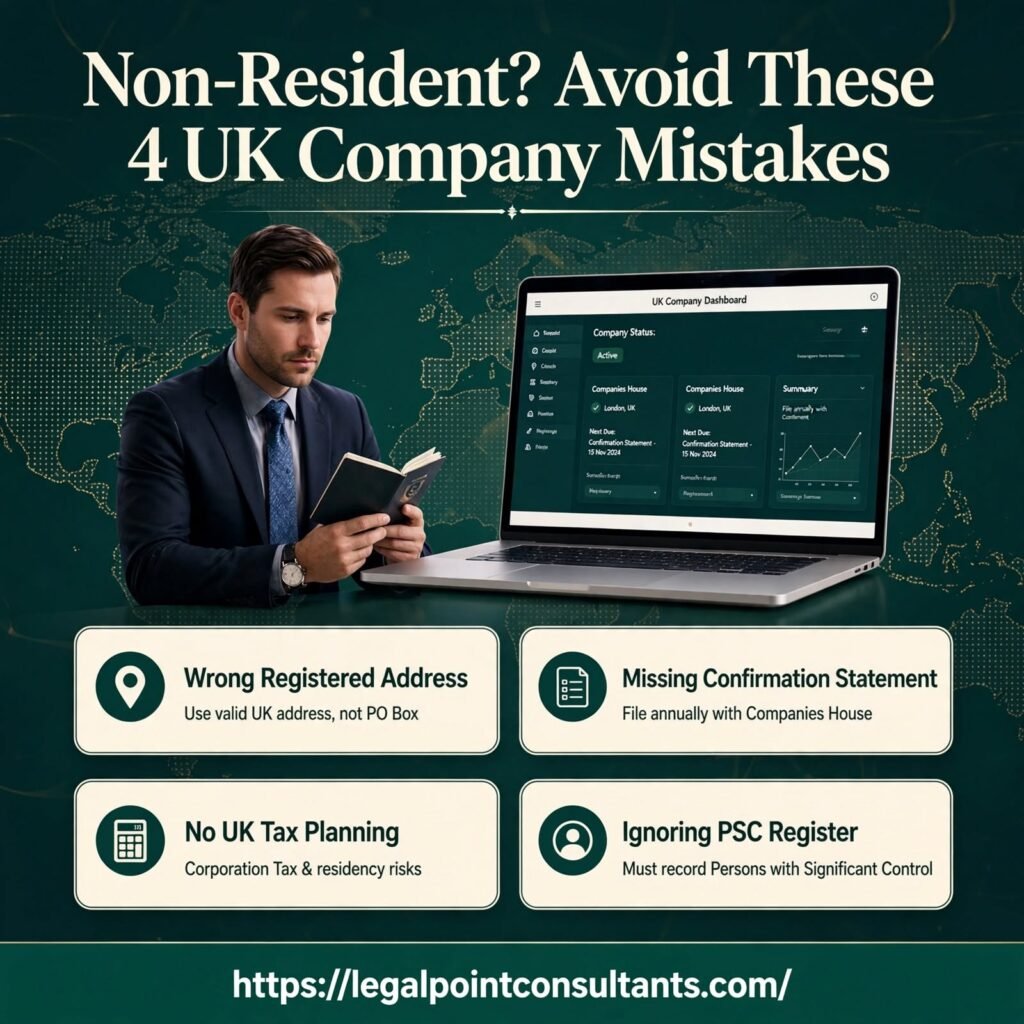
13. Common Mistakes Non-Resident Founders Should Avoid
International entrepreneurs should consider the following issues before registering a UK business.
1. Assuming UK registration creates UK residency. Incorporating a business does not automatically grant a visa, residence permit, or right to work in the UK.
2. Assuming all foreign income is tax-free. Tax treatment depends on the business’s activities, where profits arise, the owner’s tax residence, and relevant domestic law and treaties.
3. Choosing an LLP without genuine member arrangements. An LLP should have properly documented membership, management, profit allocation, and responsibilities.
4. Using an unsuitable registered office. The address must meet Companies House requirements and be capable of receiving official communications.
5. Ignoring annual filing obligations. Failure to file required accounts and statements can result in penalties and further enforcement action.
6. Treating business money as personal money. Company and LLP funds must be managed according to the relevant legal, accounting, and tax rules.
7. Assuming bank approval is automatic. Banking and payment service providers conduct their own checks and may decline applications.
14. Frequently Asked Questions
Can a non-UK resident own 100% of a UK Ltd?
Generally, yes. A qualifying non-UK resident can own all the shares in a UK private limited company, subject to applicable restrictions and registration requirements. The director does not ordinarily need to reside in the UK.
Can one person form a UK LLP?
No. A UK LLP generally requires at least two members. A founder intending to operate alone may need to consider a private limited company or another appropriate business structure.
Is a UK LLP tax-free for non-residents?
No. An LLP is generally tax-transparent for UK tax purposes when carrying on a business for profit. Non-resident members may be liable to UK tax on their share of UK-source profits. Their country of residence may also impose tax.
Can a UK Ltd have directors living in Pakistan?
A director can generally reside in Pakistan or another country, provided the person meets the applicable director eligibility and legal requirements. The company must still maintain an appropriate registered office in the UK.
Can I open a UK business bank account without visiting the UK?
Possibly. Some providers offer remote applications, but acceptance depends on their eligibility rules, identity verification, business activities, and risk assessments. Incorporation alone does not guarantee account approval.
Which structure is suitable for a foreign software startup?
The relevant considerations include the number of founders, investment plans, ownership arrangements, intellectual property, employee equity, and tax treatment. A share-based company structure and an LLP’s member-based structure offer different legal and commercial arrangements.
Does registering a UK Ltd or LLP provide a UK visa?
No. Business registration is separate from immigration permission. Founders who intend to live or work in the UK must assess the relevant visa and immigration requirements independently.
Can a UK LLP member live outside the UK?
Yes, a member can generally live outside the UK. However, the member’s tax liability, reporting obligations, and any relevant business or regulatory requirements must be considered separately.
Conclusion: Understanding the Right Business Structure for Your UK Plans
UK Ltd vs LLP for Non-Resident Founders involves more than comparing registration fees or the names of two business structures. The key considerations are ownership, legal liability, taxation, management, profit distribution, investment requirements, and ongoing compliance.
A UK Ltd has share-based ownership and is generally subject to Corporation Tax on its taxable profits. An LLP has member-based ownership and is normally tax-transparent for UK tax purposes when carrying on a business for profit.
For overseas entrepreneurs, the final decision should also account for personal tax residence, the location of business management, cross-border income, banking eligibility, and any immigration or regulatory requirements.
Before incorporating, founders should review their proposed business model and obtain appropriate UK legal and cross-border tax advice. A structure that works for one international entrepreneur may not produce the same legal or tax outcome for another.
Get Professional UK Company Formation Guidance
Legal Point Consultants
Global Business Solutions. Local Expertise. Trusted Worldwide.
Legal Point Consultants assists entrepreneurs and international business owners with company formation guidance, corporate compliance, and business structuring across relevant jurisdictions.
Contact our team to discuss your proposed UK business, ownership structure, registration requirements, and compliance considerations.