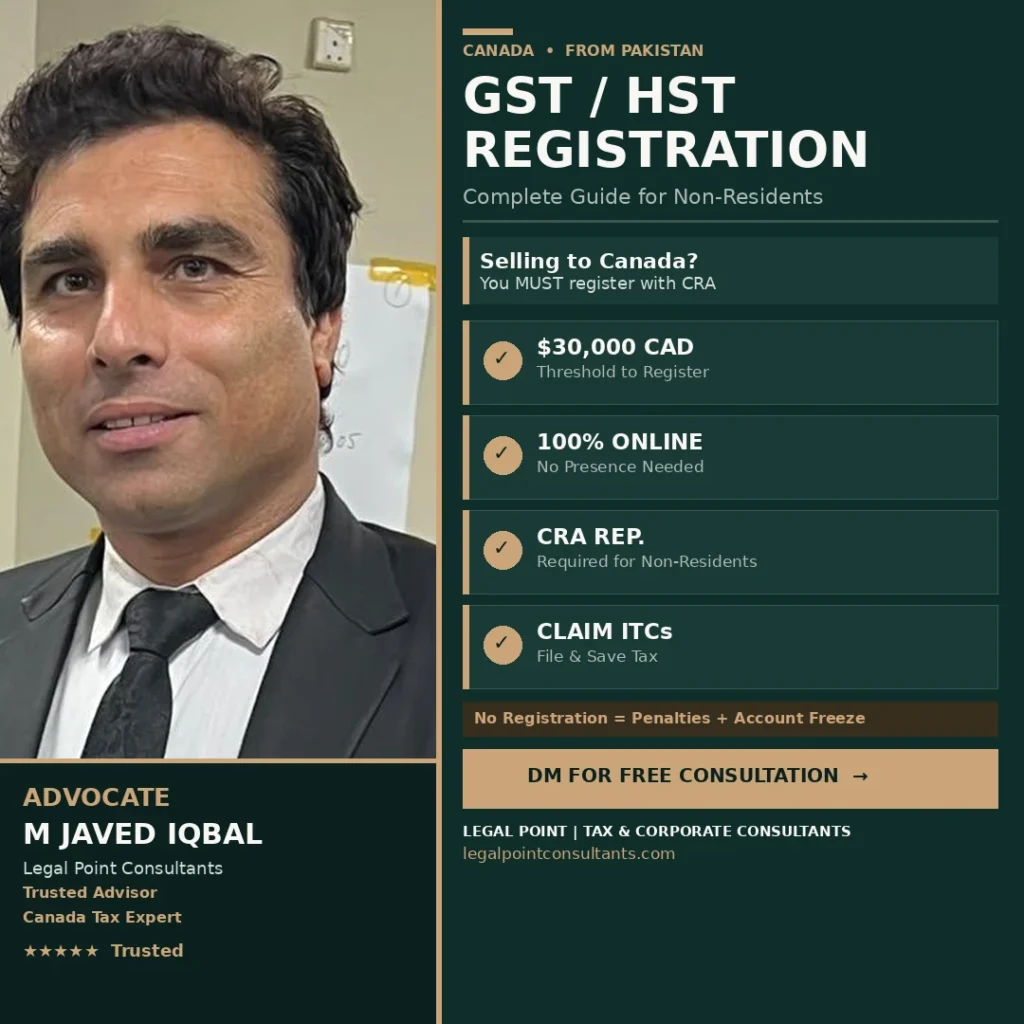
If you live in Pakistan and sell products or services to customers in Canada, you may have to register for a Canadian GST/HST account. This requirement can apply even when your business is based outside Canada and you do not have a Canadian office. The rules depend on what you sell, where your customers are located, how your business operates and whether you are considered to be carrying on business in Canada. Learn how to register for GST/HST registration in Canada from Pakistan. Understand non-resident eligibility, CRA registration, documents, tax rates, filing and compliance.
For Pakistani entrepreneurs, overseas business owners and foreign companies, understanding these rules before starting Canadian sales can help prevent registration problems, incorrect tax collection and missed filing deadlines.
This guide explains how GST/HST registration works for non-residents, which businesses may need to register, what information the Canada Revenue Agency (CRA) requires, how to apply from Pakistan and what you must do after registration.
1. What Is GST/HST in Canada?
GST stands for Goods and Services Tax. It is a federal consumption tax charged on many goods and services supplied in Canada.
HST stands for Harmonized Sales Tax. It combines the federal GST and the participating province’s sales tax into one tax.
The Canada Revenue Agency (CRA) administers GST/HST. Businesses that are registered or required to register generally collect the applicable tax from customers on taxable supplies and send the amount collected to the CRA, after calculating their net tax under the applicable rules.
What is the difference between GST and HST?
The main difference is the province or territory where the supply is made.
GST applies at the federal rate in provinces and territories that do not use HST.
HST applies in participating provinces at a combined rate.
Some provinces also have a separate Provincial Sales Tax (PST) or other provincial sales tax requirements.
For example, a taxable sale made in Alberta may attract 5% GST, while a taxable sale made in Ontario may attract 13% HST. The correct rate depends on the place-of-supply rules, not simply the seller’s country of residence.
2. Can You Register for GST/HST in Canada from Pakistan?
Yes. A business located in Pakistan can apply for a Canadian GST/HST account if it meets the applicable registration requirements.
You do not automatically need to move to Canada, become a Canadian citizen or incorporate a Canadian company before applying. The CRA has a separate registration process for non-resident businesses.
This process is relevant to businesses that are incorporated outside Canada, located outside Canada, or whose owners do not have a Canadian Social Insurance Number (SIN).
A Pakistani business may need to consider GST/HST registration if it:
Sells taxable products to customers in Canada.
Holds inventory in a Canadian warehouse.
Uses a Canadian fulfilment centre for certain sales.
Provides taxable services in Canada while carrying on business there.
Sells qualifying digital products or services to Canadian customers.
Operates through a business model covered by Canada’s digital-economy tax rules.
However, not every Pakistani business selling to a Canadian customer automatically needs to register. The correct answer depends on the type of supply and the applicable GST/HST registration regime.
There are different registration rules for non-resident businesses. Your business model is one of the most important factors in deciding whether you need a normal or simplified GST/HST account.
Pakistani companies selling physical products in Canada
Suppose a company registered in Pakistan sells products to Canadian customers. It may have GST/HST obligations if it carries on business in Canada or its sales fall under the specific rules for qualifying goods.
For example, a Pakistani seller may keep products in a Canadian fulfilment warehouse and sell them to Canadian buyers. The location of inventory and the way goods are supplied can affect the registration requirements.
E-commerce and dropshipping businesses
Online sellers should not assume that selling through a website removes Canadian tax obligations.
Your responsibilities may depend on:
Whether goods are stored in Canada.
Whether products are shipped directly from Pakistan or another country.
Whether a marketplace facilitates the sale.
Who is treated as the supplier for GST/HST purposes.
Whether you carry on business in Canada.
Marketplace operators may have their own collection responsibilities under specific rules. You should identify who is responsible for collecting tax on each type of transaction.
Consultants and professional service providers
A Pakistani consultant providing services to Canadian clients should review the nature of the service, the customer’s status, the place-of-supply rules and whether the consultant is carrying on business in Canada.
Some services supplied to non-residents may qualify for zero-rating, while other services may be taxable. A service being delivered online does not automatically make it exempt or zero-rated.
SaaS, software and digital businesses
A Pakistani software company selling subscriptions, online services, digital products or streaming services to Canadian customers may fall under Canada’s digital-economy rules.
Some non-resident digital suppliers must use the simplified GST/HST registration system when their applicable revenue exceeds the relevant threshold.
The rules differ from the normal GST/HST system, so digital businesses should identify the correct category before applying.
4. When Is GST/HST Registration Mandatory?
One common mistake is assuming that every foreign business can ignore Canadian GST/HST until it earns CAD $30,000. That is not a safe general rule.
The CAD $30,000 threshold is important, but its application depends on the registration regime and business activity.
Normal GST/HST registration and the small supplier threshold
For most businesses, the general small supplier threshold is CAD $30,000 in worldwide taxable supplies, including zero-rated supplies, calculated under the CRA rules. The revenue of associated persons may also have to be included.
If a business exceeds CAD $30,000 in a single calendar quarter, it generally stops being a small supplier on the supply that takes it over the threshold.
If it exceeds CAD $30,000 over four consecutive calendar quarters, but not in one quarter, the registration date is generally determined under the CRA’s end-of-month rule.
A business that is no longer a small supplier may have to register and charge GST/HST from its effective registration date.
Important for non-residents: The threshold is not the only test. A non-resident may have to register even when it has no permanent establishment in Canada, and certain supplies have special rules. Some businesses must register even if they are small suppliers.
Digital-economy registration threshold
Different rules apply to certain non-resident digital suppliers that are not carrying on business in Canada and are not registered under the normal GST/HST regime.
For qualifying cross-border digital products and services, the registration threshold generally looks at applicable revenue exceeding CAD $30,000 over any 12-month period.
This is not the same test as the normal small supplier calculation.
When registration may be required even below CAD $30,000
Certain activities have special rules. For example, non-residents making taxable supplies of admissions in Canada for a place of amusement, seminar, activity or event may have registration obligations even if they are small suppliers.
A non-resident hosting a convention in Canada may also have special obligations when more than 25% of attendees are Canadian residents.
Before deciding not to register, check your exact activity against the CRA’s GST/HST registration rules.
5. GST/HST Registration for Different Pakistani Business Models
Your legal structure and business activities can affect the information you provide to the CRA.
Sole proprietors and individual business owners
A Pakistani individual operating a business may be able to register as a non-resident if the applicable conditions are met. The registration is for the business activity, not simply because the person has a Canadian customer.
Pakistani private limited companies
A Pakistani incorporated company may apply using its legal business details and incorporation information. The company itself is the applicant where it is the entity making the supplies.
Canadian companies owned by Pakistani residents
A Canadian corporation owned by a Pakistani resident is not automatically treated as a non-resident business merely because its shareholder lives in Pakistan.
Its GST/HST position depends on the corporation’s own activities, structure and applicable rules. Corporate income tax and GST/HST are separate tax matters.
E-commerce and marketplace sellers
Online sellers should review whether they sell goods located in Canada, import products into Canada, use fulfilment warehouses or sell through a platform. These facts can change which registration rules apply.
Freelancers and service businesses
Freelancers should examine the nature of their services, customer location and whether they are carrying on business in Canada. They should not assume that every payment received from a Canadian customer requires GST/HST or that every international service is automatically zero-rated.
Choosing the wrong system can create reporting problems.
Normal GST/HST registration
The normal system is generally relevant to businesses carrying on business in Canada and certain non-resident suppliers of qualifying goods.
Under this system, a registrant may have to:
Charge GST/HST on taxable supplies where required.
File GST/HST returns for each reporting period.
Remit net tax to the CRA.
Maintain appropriate business records.
Review whether it can claim eligible Input Tax Credits (ITCs).
Simplified GST/HST registration
The simplified system is designed for certain non-resident digital-economy businesses.
It generally applies to qualifying cross-border digital products and services and certain platform-based short-term accommodation supplies.
Under the simplified system:
The business follows the simplified registration and reporting rules.
The reporting period is quarterly.
The fiscal year-end is December 31.
Input Tax Credits generally cannot be claimed.
The normal non-resident security deposit is not required.
A qualifying foreign currency arrangement may be available, subject to CRA approval.
A business required to register under the simplified system may be able to apply voluntarily for normal registration if it meets the relevant conditions. It cannot be registered under both systems at the same time.
Important: The simplified system is not a general alternative for every foreign company. For example, non-resident businesses covered by the qualifying-goods measure must use normal GST/HST registration.
7. Documents and Information Required for GST/HST Registration from Pakistan
The CRA may ask for information about your business, owners, activities and incorporation. The exact requirements depend on your registration type.
Preparing the following information before starting can make the application process easier.
Business information
Prepare:
Full legal name of the business.
Trading or operating name, if different.
Business type, such as sole proprietorship, partnership or corporation.
Country of incorporation, where applicable.
Incorporation date and certificate details, where applicable.
Physical business address in Pakistan.
Mailing address, if different.
Address where business records are maintained.
Business email and website, if available.
A clear description of your business activities.
Owner, director or partner information
You may need to provide the names, titles and contact details of the owner, partners, directors or officers.
The CRA may also request tax identification details where applicable.
Sales and registration information
Depending on your business, prepare:
Estimated or actual Canadian sales.
Expected date of registration.
Description of products or services.
Details of Canadian customers or transactions.
Information about Canadian inventory or warehouses, if applicable.
Relevant supporting documents requested by the CRA.
For an incorporated business, incorporation or formation documents may be requested. The CRA may ask for additional supporting information after reviewing an application.
A passport or Pakistani identity document should not be treated as a substitute for all business-registration requirements. Follow the document instructions for the specific application.
8. How to Register for GST/HST in Canada from Pakistan
The CRA provides a dedicated online process for non-resident business registration. You can use it to apply for a Business Number and certain CRA program accounts.
Step 1: Identify your registration category
First, establish whether your business needs:
Normal GST/HST registration.
Simplified GST/HST registration.
Another tax account in addition to GST/HST.
This decision depends on your business activities and the relevant CRA rules.
Step 2: Prepare your business details
Collect your legal name, business address, incorporation information, owner or director details, business activity description and sales estimates.
Make sure your information is consistent across your incorporation documents and application.
Step 3: Open the CRA non-resident registration form
The online form is intended for businesses incorporated outside Canada, businesses located outside Canada and individuals who do not have a SIN, among other eligible applicants.
Step 4: Apply for a Business Number and GST/HST account
The non-resident online form allows eligible applicants to register for a Business Number (BN) and certain CRA program accounts, including GST/HST (RT).
Choose the relevant account options and enter the requested information carefully.
Step 5: Submit the application and respond to CRA requests
Review all details before submission. If the CRA requests supporting documents or clarification, provide the information through the method and within the timeframe specified.
For some normal non-resident registrations, the CRA may request supporting documents after the online application. Its guidance explains that requested documents may need to be sent to the designated non-resident tax services office within 10 business days.
Step 6: Keep your registration details safe
Once the CRA has processed your application, keep your Business Number and GST/HST account details with your business records.
Check that the account details and effective registration date are correct before charging tax to customers.
What if the online registration form is not available for your situation?
The CRA also provides a paper registration route for certain cases. Form RC1, Request for a Business Number and Certain Program Accounts, may be used where the online route is not available for the account you need.
Follow the current CRA instructions for the correct mailing or fax destination. Do not send documents to an address copied from an old guide without checking the current instructions.
9. What Is a Canadian Business Number (BN)?
A Business Number (BN) is a unique nine-digit number issued by the CRA to identify a business.
A business may use its BN to access different CRA program accounts.
For GST/HST, the business normally has an RT program account attached to its BN. A typical GST/HST account number contains the nine-digit BN followed by RT and a four-digit reference number.
For example, a format may look like this:
123456789 RT0001
This is only an example, not an actual business registration number.
A BN is not the same as a GST/HST account. The BN identifies the business, while the RT account identifies its GST/HST program account.
10. Security Deposit for Non-Resident GST/HST Registration
Some non-resident businesses registering under the normal GST/HST system may have to provide a security deposit to the CRA.
Generally, this requirement can apply when the business does not have a permanent establishment in Canada or makes supplies in Canada only through another person’s fixed place of business.
How much security may be required?
The CRA generally calculates the initial security as 50% of the estimated net tax for the 12-month period after registration.
For later years, the amount is generally based on 50% of the actual net tax for the previous 12-month period.
The CRA’s non-resident guide states that the security deposit has a minimum of CAD $5,000 and a maximum of CAD $1 million.
Is every non-resident required to provide security?
No. An exception may apply if the business estimates that its annual taxable supplies in Canada will not exceed CAD $100,000 and its annual net tax will be between CAD $3,000 payable and CAD $3,000 refundable.
The CRA also states that simplified GST/HST registrants do not have to provide the normal non-resident security deposit.
The exact security requirement should be confirmed with the CRA for your circumstances. Review the official CRA non-resident GST/HST guide.
11. GST/HST Rates Across Canadian Provinces
The applicable GST/HST rate depends on the place-of-supply rules and the type of transaction.
The following table shows the general GST/HST rates listed by the CRA. It does not include separate provincial sales taxes.
Province or territory
GST/HST rate
Alberta
5% GST
British Columbia
5% GST
Manitoba
5% GST
New Brunswick
15% HST
Newfoundland and Labrador
15% HST
Northwest Territories
5% GST
Nova Scotia
14% HST
Nunavut
5% GST
Ontario
13% HST
Prince Edward Island
15% HST
Quebec
5% GST
Saskatchewan
5% GST
Yukon
5% GST
Some provinces also impose separate PST or other provincial taxes. For example, British Columbia, Manitoba, Quebec and Saskatchewan have separate provincial sales tax systems.
How do you determine which rate to charge?
You should consider:
What you are selling.
Whether the supply is taxable, exempt or zero-rated.
Where the supply is considered to be made.
Whether a special place-of-supply rule applies.
For example, a taxable product delivered to an Ontario customer may attract Ontario’s 13% HST even if the seller operates from Pakistan.
Registration is only the beginning. You must also follow the ongoing GST/HST rules that apply to your account.
Charge and collect the correct tax
Once your effective registration date begins, charge the correct GST/HST on taxable supplies where required.
Your invoices and accounting records should clearly show the applicable tax information.
Keep proper business records
Keep sales invoices, purchase receipts, accounting records, tax calculations, import documents and other supporting information.
Good records help you prepare accurate returns and respond to CRA questions.
File GST/HST returns
Registered businesses generally have to file a return for every reporting period, even if they had no sales or tax to report.
A return with no activity is commonly called a nil return.
Pay or remit the net tax
Your net tax is generally calculated by taking the GST/HST collected or collectible and subtracting eligible Input Tax Credits and other permitted adjustments.
The balance is then paid to the CRA, or a refund may be available.
13. GST/HST Filing Deadlines and Reporting Periods
The CRA assigns reporting periods based on the business and applicable rules. Some businesses file monthly, some quarterly and others annually.
For most normal GST/HST registrants:
Monthly returns are generally due one month after the reporting period ends.
Quarterly returns are generally due one month after the reporting period ends.
Annual returns are generally due three months after the fiscal year-end.
There are special deadlines for certain sole proprietors and other categories.
For simplified GST/HST registrants, the reporting period is quarterly, with a December 31 fiscal year-end under the simplified regime.
Always check the due date assigned to your specific account. Filing and payment deadlines can differ in special situations.
14. Can Pakistani Businesses Claim Input Tax Credits?
Under the normal GST/HST system, eligible registrants may be able to recover GST/HST paid or payable on qualifying business purchases and expenses through Input Tax Credits (ITCs).
For example, a business may incur GST/HST on eligible operating expenses, equipment or services used in its commercial activities. If the expenses meet the CRA requirements, the business may be able to claim the relevant ITCs.
However, not every expense qualifies. You must meet the documentation, business-use and other requirements.
Important: Businesses registered under the simplified GST/HST system generally cannot claim Input Tax Credits. This is one of the key differences between the normal and simplified systems.
15. Common GST/HST Registration Mistakes Pakistani Non-Residents Should Avoid
Foreign business owners can create tax problems by misunderstanding the Canadian rules. Some common mistakes include:
Assuming the CAD $30,000 threshold applies to every business in the same way
Normal registration and digital-economy registration use different threshold tests. Certain activities may also have special registration rules.
Choosing the wrong GST/HST account
A digital service provider and a seller of qualifying goods may have different registration requirements. Selecting the wrong account type can affect reporting and tax recovery.
Assuming a Canadian company is always required
A foreign business may be able to register as a non-resident without incorporating in Canada. GST/HST registration and company incorporation are separate matters.
Ignoring the security deposit requirement
Some non-resident businesses under the normal system may need to provide security. Ignoring this requirement can delay or complicate compliance.
Charging the wrong GST/HST rate
The rate depends on the type and place of supply. Applying one rate to every Canadian customer may lead to incorrect tax collection.
Missing filing deadlines
Registered businesses generally need to file returns for every reporting period, including periods with no activity.
Confusing GST/HST with corporate income tax
GST/HST is a consumption tax. Corporate income tax is a separate tax on business profits. Registering for one does not automatically resolve every other Canadian tax obligation.
16. GST/HST Registration vs Canadian Company Incorporation
GST/HST registration and company incorporation serve different purposes.
GST/HST registration creates a tax account for a business that has GST/HST registration obligations or chooses to register voluntarily where permitted.
Company incorporation creates a legal corporate entity under the applicable Canadian federal or provincial law.
A Pakistani company may be able to register for GST/HST as a non-resident without creating a new Canadian corporation, depending on its activities and registration requirements.
On the other hand, an entrepreneur who wants to establish a Canadian company may need to consider incorporation, corporate income tax, business licensing, banking and other compliance matters separately.
The right structure depends on your business objectives, customers, operations and tax position. Do not incorporate a Canadian company simply because you assume it is compulsory for GST/HST registration.
17. How Legal Point Consultants Can Help with GST/HST Registration in Canada
Registering for GST/HST from Pakistan can involve more than completing an online form. You first need to understand your business model, identify the correct registration category and prepare accurate information for the CRA.
Legal Point Consultants provides cross-border corporate, tax and compliance support for entrepreneurs, companies and international business owners.
Our taxation services cover registration, tax filings, compliance and support across multiple jurisdictions, including Canada.
We can help assess your GST/HST registration requirements, review your business information, guide you through the relevant CRA registration process and support your ongoing GST/HST filing and compliance needs.
Our team can assist with:
Reviewing whether your business may need GST/HST registration.
Identifying the appropriate normal or simplified registration route.
Preparing business information for the CRA application.
Understanding filing and payment responsibilities.
Organising ongoing tax compliance requirements.
Every business has different facts. We assess your circumstances before recommending a registration or compliance route.
Get Professional GST/HST Registration Support from Pakistan
If you are a Pakistani entrepreneur, overseas business owner or foreign company planning to sell products or services in Canada, getting the right tax guidance before starting can help you avoid unnecessary compliance issues.
Contact Legal Point Consultants to discuss your business activities and Canadian GST/HST requirements.
Advocate M. Javed Iqbal is associated with Legal Point and provides legal guidance and assistance in corporate and business law, taxation, legal compliance, and other legal matters. He aims to help individuals, entrepreneurs, and businesses understand their legal rights, obligations, and available legal options.
Corporate and Business Law
Advocate M. Javed Iqbal provides legal guidance and assistance in corporate and business law matters, helping entrepreneurs, business owners and companies understand their legal responsibilities and protect their business interests.
Key Areas of Practice:
Company formation and business registration guidance
Drafting, reviewing and vetting business agreements and contracts
Partnership and shareholder disputes
Corporate documentation and legal matters
Business transactions and commercial agreements
Corporate governance and regulatory compliance
Legal Support: Helping businesses understand legal requirements, review contractual obligations, address corporate disputes and make informed decisions in accordance with applicable laws.
Tax and Legal Compliance
Advocate M. Javed Iqbal assists individuals, entrepreneurs and businesses with legal matters involving taxation, statutory obligations and regulatory compliance. His approach focuses on helping clients understand tax-related legal requirements and respond appropriately to compliance issues.
Key Areas of Practice:
NTN and tax registration-related legal guidance
Income tax notices and related legal matters
Tax disputes and representation, where applicable
Tax documentation and compliance guidance
Business taxation obligations
Responses to notices from relevant tax authorities
Legal guidance on statutory and regulatory requirements
Legal Support: Assisting clients in understanding tax-related legal obligations, addressing compliance concerns and navigating legal issues involving relevant tax authorities.
18. Frequently Asked Questions About GST/HST Registration in Canada from Pakistan
1. Can I register for GST/HST in Canada while living in Pakistan?
Yes. Eligible businesses located or incorporated outside Canada can use the CRA’s non-resident registration process. Whether you need to register depends on your business activities and the applicable GST/HST rules.
2. Do I need a Canadian company to get a GST/HST number?
Not necessarily. A foreign business may be able to register as a non-resident without incorporating a Canadian company. GST/HST registration and incorporation are separate processes.
3. Can a Pakistani company get a Canadian Business Number?
Yes. Eligible non-resident businesses can apply for a Canadian Business Number through the CRA’s non-resident business registration process.
4. Is the CAD $30,000 threshold applicable to Pakistani businesses?
It can be relevant, but the correct calculation depends on the registration regime. Normal GST/HST small supplier rules and the digital-economy threshold rules are different. Some non-resident activities also have special requirements.
5. Can I register for GST/HST without a Canadian office?
A Canadian office is not always necessary. The CRA has a registration process for non-resident businesses. However, your business activity and whether you are carrying on business in Canada can affect your tax obligations.
6. What documents are required for non-resident GST/HST registration?
You should prepare your legal business name, business address, incorporation information where applicable, owner or director details, business activity description and relevant sales information. The CRA may request supporting documents depending on your application.
7. What is the difference between a BN and a GST/HST number?
A Business Number is a nine-digit identifier issued by the CRA. A GST/HST account is a program account attached to that BN and normally uses the RT identifier.
8. Do non-residents have to pay a security deposit?
Some non-residents registering under the normal GST/HST system generally have to provide security. Exceptions may apply, and simplified GST/HST registrants do not have the normal non-resident security requirement.
9. Can I file Canadian GST/HST returns from Pakistan?
Yes. Eligible businesses can manage their Canadian GST/HST compliance from outside Canada using the available CRA filing and payment arrangements. You must follow the reporting period and deadlines assigned to your account.
10. Can a Pakistani software company register for GST/HST in Canada?
It may need to register if it supplies qualifying digital products or services to Canadian customers and meets the relevant digital-economy requirements. The type of customer, revenue threshold and registration status all matter.
11. Can I claim GST/HST paid on business expenses?
Eligible registrants under the normal GST/HST system may be able to claim Input Tax Credits if they meet the CRA requirements. Simplified GST/HST registrants generally cannot claim ITCs.
12. Is GST/HST the same as Canadian corporate income tax?
No. GST/HST is a consumption tax on taxable supplies. Corporate income tax is a separate tax that may apply to a corporation’s taxable income. A business should review both sets of obligations separately.
13. What happens if I do not register when registration is required?
Failing to register when required can result in tax assessments, interest and penalties. You may also become responsible for GST/HST that should have been collected from customers. The consequences depend on the facts and applicable rules.
14. Can I voluntarily register for GST/HST in Canada?
Some businesses that are small suppliers and make taxable supplies in Canada may choose to register voluntarily. However, voluntary registration creates ongoing responsibilities, including charging tax where required and filing returns.
15. Can Legal Point Consultants help with GST/HST registration from Pakistan?
Legal Point Consultants can review your business circumstances and provide support with Canadian GST/HST registration and tax compliance. Contact the team to discuss your business model and the appropriate registration route.
Important Tax Disclaimer
This guide provides general information about Canadian GST/HST rules for non-resident businesses. It is not a substitute for advice based on your specific business activities, contracts, customers, sales, corporate structure and registration history. GST/HST rules can change, and special rules may apply to particular industries and transactions. Always verify current requirements with the Canada Revenue Agency or a qualified Canadian tax professional before making a registration or tax decision.
Need this handled for your business?
Our consultants can apply exactly what you’ve just read to your own jurisdiction and entity.