VAT Accounting & Tax Agent Services in UAE: Simplified for Your Business
VAT Accounting & Tax Agent Services in UAE Managing VAT, bookkeeping, invoices, financial records and tax deadlines can become complicated as a UAE business…
Read more
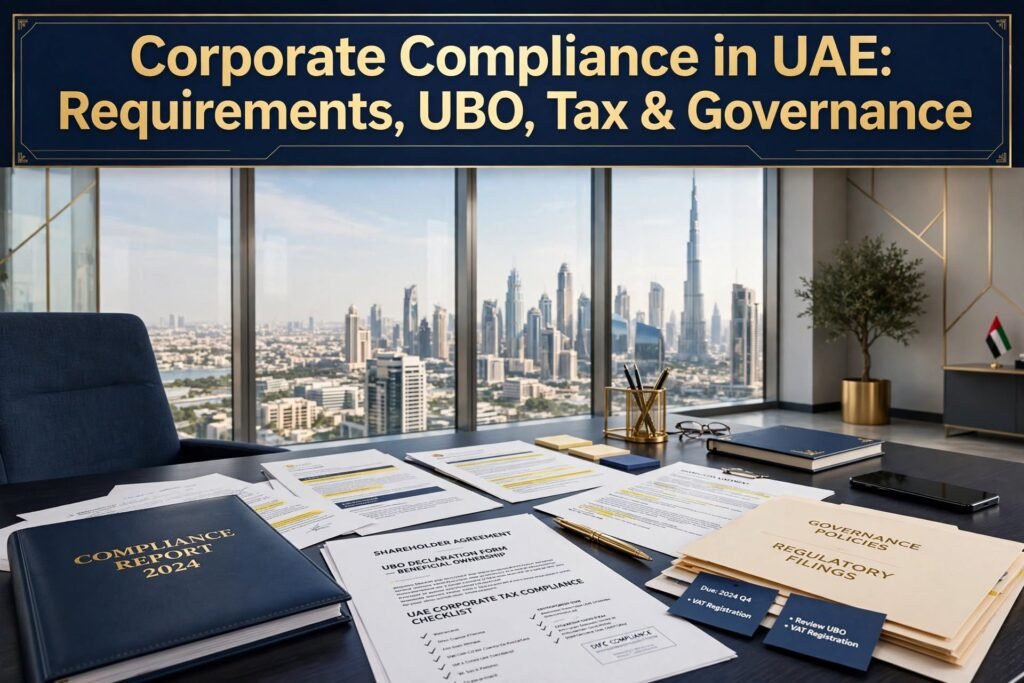
Starting a company in the United Arab Emirates is only the beginning of running a legally sound business. After incorporation, companies may have ongoing obligations involving corporate records, ownership information, licences, tax, regulatory filings, governance and sector-specific requirements.
This ongoing responsibility is commonly referred to as corporate compliance in the UAE.
For business owners, founders and foreign investors, compliance is not simply about submitting forms before a deadline. It is about keeping company information accurate, maintaining required records, meeting applicable regulatory requirements and ensuring that the business remains properly administered.
The exact obligations can differ depending on whether the company operates on the mainland or in a free zone, which authority regulates it, what activities it conducts and whether additional tax or regulated-sector requirements apply.
Legal Point Consultants provides corporate compliance support designed to help businesses identify their obligations, organise compliance calendars, maintain corporate records and manage recurring filings.
Corporate compliance is the ongoing process of ensuring that a company follows the laws, regulations, licensing conditions and administrative requirements applicable to its business.
Unlike company formation, which is generally a one-time process, compliance continues throughout the life of the company.
Depending on the structure and regulatory environment, corporate compliance may involve:
The UAE Ministry of Economy and Tourism maintains an AML/CFT framework and supervises relevant Designated Non-Financial Businesses and Professions (DNFBPs), making compliance particularly important for businesses and professional sectors covered by the applicable regulations.
A business can be legally established and still develop compliance problems later.
Missed filings, outdated ownership information, expired licences or incomplete corporate records can create administrative and financial risks. The consequences depend on the relevant authority and the nature of the violation, but may include penalties, late fees, restrictions, loss of good standing or other regulatory action.
Good compliance management helps a company:
Changes involving directors, shareholders, ownership or company details should be reflected in the relevant records and filings where required.
Different obligations may fall due at different times. A structured compliance calendar allows businesses to track these dates rather than relying on memory.
Banks, investors, counterparties and other stakeholders may request corporate documents, ownership information or evidence of regulatory compliance as part of their due diligence.
Proper resolutions, minutes, statutory registers and documented decision-making create a clearer record of how the company is managed.
Compliance should be treated as an ongoing business function rather than something addressed only when a deadline or regulatory problem appears.
There is no single checklist that applies identically to every company in the UAE. The requirements depend on the company’s legal form, licensing authority, activity and other circumstances.
However, several areas commonly require attention.
Certain UAE entities may have periodic filing or information-update requirements imposed by their relevant licensing or registration authority.
These filings can be used to confirm or update information such as company details, directors, shareholders or registered information, depending on the applicable regime.
Because mainland and free-zone requirements can differ, businesses should verify the requirements of their specific authority rather than assuming that one filing timetable applies to every UAE company.
A professional compliance review can help identify:
Ultimate Beneficial Ownership (UBO) is an important part of the UAE’s corporate transparency framework.
Under Cabinet Decision No. 109 of 2023 on the Regulation of the Real Beneficiary Procedures, legal persons are required to take reasonable measures to obtain and maintain adequate, accurate and up-to-date beneficial ownership information, subject to the rules and exemptions that apply. The decision also establishes requirements concerning the Beneficial Owner Register and updating changes.
In practical terms, businesses should understand who ultimately owns or controls the entity and ensure that required information is properly maintained.
UBO compliance may require attention when there is a change in:
Keeping beneficial ownership information current is therefore an important part of corporate administration.
Corporate tax has become a significant part of the UAE business compliance environment.
The Federal Tax Authority states that persons subject to UAE Corporate Tax are required to register and obtain a Corporate Tax Registration Number in accordance with the applicable law and implementing decisions.
Corporate tax compliance may involve more than registration. Depending on the company and its circumstances, businesses may need to manage:
Businesses should evaluate their tax position carefully instead of assuming that incorporation in a free zone or another structure automatically removes all tax compliance responsibilities.
VAT compliance is another important area for businesses that fall within the UAE VAT regime.
The Federal Tax Authority currently states that a UAE-resident business generally becomes mandatorily required to register for VAT when taxable supplies and imports exceed AED 375,000 over the previous 12 months or are expected to exceed that threshold in the next 30 days. Voluntary registration is available above AED 187,500, subject to the applicable conditions.
For registered businesses, VAT compliance can include:
The correct VAT treatment can depend on the nature and location of supplies, so businesses should obtain appropriate tax advice for their circumstances.
Economic Substance Regulations may be relevant to certain companies and activities in the UAE.
The UAE Government explains that entities carrying out relevant activities may be required to meet economic substance requirements and submit the relevant notification and, where applicable, Economic Substance Report to their regulatory authority. Whether the rules apply depends on the entity’s activities, income and other applicable conditions.
This means companies should not automatically assume that Economic Substance requirements apply or do not apply to them.
A proper compliance assessment should first determine whether the business falls within the relevant scope.
Corporate compliance also includes maintaining organised company records.
Depending on the applicable company structure and authority, this can include:
Accurate records help demonstrate that important company decisions were properly documented and that the company is being administered in an organised manner.
A valid business licence is fundamental to lawful business operations in the UAE.
Companies should monitor the renewal dates for their relevant trade licence and any additional permits or approvals connected with their activities.
The exact process and requirements vary according to the licensing authority, business activity and jurisdiction.
A compliance calendar can help companies monitor:
Licence renewal → Corporate filings → UBO updates → Tax obligations → Regulatory requirements
This reduces dependence on last-minute action.
Corporate compliance and corporate governance are closely connected, but they are not exactly the same.
Compliance focuses on meeting applicable legal and regulatory obligations.
Governance concerns how the company is directed, managed and controlled, including decision-making, accountability and internal corporate procedures.
Effective governance may involve:
For growing businesses, strong governance can become increasingly important as ownership structures, investors and management responsibilities become more complex.
Businesses operating in sectors subject to UAE AML/CFT regulations may have additional compliance responsibilities.
The UAE Ministry of Economy and Tourism identifies DNFBP sectors under its supervisory framework and provides guidance intended to help regulated entities understand and meet their applicable AML/CFT obligations.
Depending on the business, relevant compliance measures may include customer due diligence, risk assessment, record keeping, reporting and internal controls.
Because AML requirements are sector-specific, companies should determine exactly which obligations apply to their activities.
One common misconception is that all UAE companies follow exactly the same compliance process.
In reality, the applicable requirements can differ between:
Mainland companies
and
Free zone companies
The relevant licensing authority, company structure, regulated activity and specific circumstances can affect filing requirements, renewal procedures, corporate records and regulatory obligations.
For this reason, a business should maintain a company-specific compliance checklist rather than relying on a generic UAE compliance list found online.
The consequences of non-compliance vary depending on the obligation, regulator and circumstances.
Potential consequences may include:
The earlier a compliance issue is identified, the easier it may be to understand the available corrective steps.
A company that has missed deadlines should first determine exactly what is overdue, which authority is involved and whether penalties or additional filings apply.
A practical compliance calendar should be maintained for every legal entity.
Start by recording:
1. Company Details
Legal name, registration number, licence authority and company structure.
2. Licence Dates
Trade licence and applicable permit renewal dates.
3. Ownership Information
Shareholders, directors and beneficial ownership records.
4. Tax Obligations
Corporate Tax and VAT requirements, where applicable.
5. Corporate Filings
Registrar or authority-specific filing dates.
6. Governance Actions
Board meetings, shareholder resolutions and other required formalities.
7. Regulatory Obligations
Sector-specific approvals and AML/CFT requirements where applicable.
The compliance calendar should then be reviewed regularly because regulations and administrative requirements can change.
Managing corporate compliance internally can become difficult when a company has multiple deadlines, ownership changes, tax obligations or cross-border structures.
Legal Point Consultants provides corporate compliance support for businesses that need structured, ongoing compliance management.
Its corporate compliance service covers areas including:
The firm’s stated process begins with a compliance review, followed by a tailored compliance calendar, filing and maintenance, and ongoing monitoring.
This approach is designed to move compliance from a reactive process to an actively managed business function.
Corporate compliance requires more than submitting documents.
Businesses need to understand what applies to their legal entity, what deadlines matter and what records need to remain current.
Legal Point Consultants positions its corporate compliance service around:
Multi-Jurisdiction Support: Compliance support across the UAE and other markets served by the firm.
Deadline Management: A compliance calendar for recurring obligations.
Corporate Record Maintenance: Statutory registers, resolutions, minutes and related records.
Legal and Business Focus: Compliance handled as part of broader corporate legal and business support.
Ongoing Monitoring: Reviewing regulatory developments and keeping obligations aligned with applicable requirements.
Professional assistance may be useful when:
A compliance review can help identify the obligations that apply to the particular company rather than treating every UAE business in the same way.
Corporate compliance is the ongoing process of meeting the legal, regulatory, tax, licensing and corporate administration requirements that apply to a UAE company.
Every company must comply with the rules applicable to its particular structure and activities, but the exact obligations are not identical for every business. Requirements can differ between mainland and free-zone entities, licensing authorities and regulated activities.
UBO compliance relates to identifying and maintaining accurate information about the natural person or persons who ultimately own or control a legal entity, in accordance with the applicable UAE beneficial ownership framework.
Taxable persons are required to register for UAE Corporate Tax in accordance with the applicable Corporate Tax law and implementing decisions. The Federal Tax Authority provides the registration process and related guidance.
VAT registration depends on the applicable conditions and thresholds. For UAE-resident businesses, the FTA currently identifies AED 375,000 as the mandatory registration threshold and AED 187,500 as the voluntary registration threshold, subject to the relevant rules.
Legal Point Consultants states that it can review lapsed obligations, assist with overdue filings and help establish an ongoing compliance calendar, with the appropriate approach depending on the jurisdiction and the company’s specific position.
Corporate compliance in the UAE should not be viewed as a once-a-year administrative task. It is an ongoing process involving company records, ownership transparency, licensing, governance, tax and other regulatory responsibilities.
The most effective approach is to understand your company’s specific obligations, record important deadlines, maintain accurate corporate information and review compliance regularly.
For businesses that want professional support, Legal Point Consultants provides corporate compliance services covering filings, UBO compliance, company secretarial work, governance, regulatory obligations and compliance calendar management.
Need help keeping your UAE company compliant? Contact Legal Point Consultants for a corporate compliance review and discuss the requirements applicable to your business.
Website: https://legalpointconsultants.com
 Taxation & Compliance
VAT Accounting & Tax Agent Services in UAE Managing VAT, bookkeeping, invoices, financial records and tax deadlines can become complicated as a UAE business…
Read more Taxation & Compliance
Corporate tax and VAT are now established across the Gulf. Here is what businesses operating in the GCC need to know.
Read more Taxation & Compliance
UAE Corporate Tax Registration for New Companies: Requirements, Process and Deadlines (2026 Guide) Starting a new company in the UAE involves more than obtaining…
Read more