UK Ltd vs LLP for Non-Residents Founders: Tax, Costs & Setup (2026-2027)
UK Ltd vs LLP for Non-Resident Founders: Which Business Structure Should You Choose? UK Ltd vs LLP for Non-Resident Founders is an important consideration…
Read more
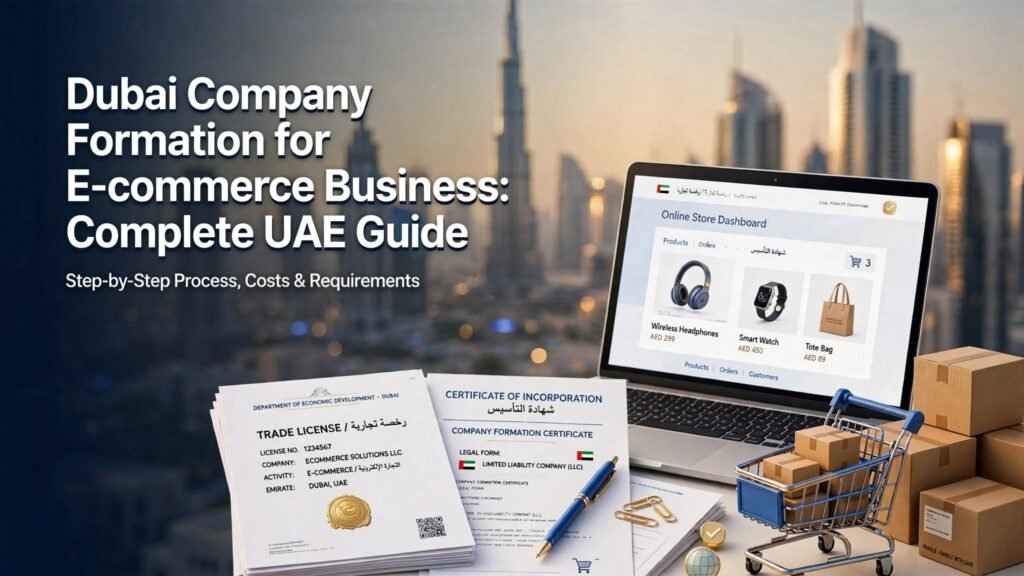
Dubai has become an attractive location for entrepreneurs who want to build and operate an online business. Its international customer base, business infrastructure, logistics network, digital economy and access to regional markets make it a popular choice for e-commerce entrepreneurs.
However, launching an online store in Dubai involves more than creating a website and adding products. Entrepreneurs need to choose the appropriate business activity, legal structure and licence, understand whether mainland or free-zone setup is more suitable, and meet applicable tax and compliance requirements.
If you are planning Dubai company formation for an e-commerce business, this guide explains the main steps and considerations you should understand before starting.
Dubai provides access to a large consumer market as well as customers across the wider Middle East and international markets.
An e-commerce company can operate through its own website, mobile application, social media channels or digital marketplaces. The UAE Government specifically recognises websites, mobile applications, social media platforms and digital marketplaces within its e-commerce framework.
Dubai can therefore be suitable for different online business models, including:
The right structure depends on what you intend to sell, where your customers are located and how you plan to operate the business.
An online business needs the appropriate licence and approvals for its activities.
For mainland e-commerce activities, the UAE Government explains that businesses need a commercial licence that includes the relevant e-commerce activity from the emirate’s economic department. In Dubai, this involves the Department of Economy and Tourism.
The exact licensing requirements can vary according to the business activity and products.
For example, selling ordinary consumer products may involve different requirements from selling regulated products such as certain food, healthcare, cosmetics or other controlled products.
Therefore, choosing the correct activity before applying for the licence is an important part of company formation.
One of the first decisions for an entrepreneur is whether to establish the company on the Dubai mainland or in a free zone.
A mainland structure can be useful for businesses that want to operate directly within the UAE market.
The UAE Government’s current business setup guidance lists the general mainland process as identifying the business activity, selecting a legal form, applying for a trade licence, registering the trade name, obtaining initial approval, arranging the required constitutional documents, selecting a business location, obtaining additional approvals where necessary, and submitting documents and fees.
Free zones can be attractive for digital businesses and companies focused on international operations.
The UAE Government states that free zones offer specialised licences for businesses selling products and services online, including businesses targeting local and international markets. It lists options such as Dubai CommerCity and EZDubai among the free-zone options supporting e-commerce activities.
However, entrepreneurs should not assume that every free-zone structure automatically provides unrestricted access to the UAE mainland market. The UAE Government notes that free-zone businesses may require a local distributor or additional approvals or arrangements when selling directly into the mainland.
The best option therefore depends on your business model rather than simply choosing the cheapest licence.
Foreign entrepreneurs can establish businesses in the UAE, subject to the applicable activity, legal structure and regulatory requirements.
The UAE Government states that amendments to the Commercial Companies Law allow 100% foreign ownership of mainland companies for eligible activities, although certain strategic or restricted activities can have additional requirements or ownership restrictions.
For an international e-commerce entrepreneur, this means ownership should be assessed according to the exact business activity and legal structure selected.
A professional company-formation review can help determine whether your planned activity is eligible and which setup is appropriate.
The exact documents depend on the legal form, activity and licensing authority.
Common documentation can include identification documents for shareholders and managers, proposed company information, trade-name details and constitutional documents.
For mainland company formation, the UAE Government lists documents such as initial approval documentation, lease-related documents, the Memorandum of Association where applicable and additional government approvals where required.
Additional documentation may be required when the business involves regulated products, foreign corporate shareholders or specific activities.
It is therefore better to prepare the document checklist after selecting the business activity and jurisdiction.
Start by identifying exactly what the company will do.
Will you sell physical products, digital products, subscriptions, services or operate a marketplace?
The business activity forms the foundation of the licensing process. UAE Government guidance notes that investors can select from a large range of business activities and that the activity influences the legal form and licence.
Compare the two structures based on:
Avoid choosing a jurisdiction solely because its initial package appears cheaper.
The legal form should match the business activity and operational requirements.
For a company structure, an LLC may be appropriate in many situations, but the correct choice depends on the exact circumstances.
Your company needs an appropriate trade name.
The UAE Government states that a trade name should comply with applicable naming requirements and must not already be registered by another business.
Initial approval allows the setup process to continue, but it does not itself mean that the business can immediately begin operating.
Additional approvals can be necessary for particular regulated activities.
Business-location requirements depend on the selected jurisdiction and legal structure.
For mainland businesses, the UAE Government states that businesses must have a physical address and that the premises must comply with the relevant emirate and municipality requirements.
Once the required steps and approvals are completed, the relevant authority can issue the commercial licence.
At this stage, the company can proceed with the other operational requirements needed for its e-commerce business.
VAT is an important consideration for an online business.
The UAE Federal Tax Authority states that a UAE-resident business must register for VAT when the value of its taxable supplies and imports exceeds AED 375,000 over the previous 12 months or is expected to exceed that amount within the next 30 days. Voluntary registration may be available from AED 187,500, subject to the applicable rules.
These thresholds should not be treated as a simple rule for every business because VAT treatment can vary depending on the nature of supplies, imports, residency and other circumstances.
E-commerce entrepreneurs should therefore assess their transaction structure and customer locations before determining their VAT obligations.
Dubai e-commerce companies also need to consider UAE Corporate Tax.
The Federal Tax Authority states that taxable persons are required to register for UAE Corporate Tax in accordance with the applicable Corporate Tax law and implementing decisions.
The UAE Government also confirms that Corporate Tax can apply to businesses operating under commercial licences, including qualifying free-zone businesses subject to the relevant rules.
Importantly, a free-zone company should not be described simply as “tax-free.” Corporate Tax treatment depends on the applicable legislation and whether the business meets the conditions for any available treatment.
E-commerce businesses should maintain proper accounting records and assess their Corporate Tax registration and filing responsibilities from the beginning.
Company formation is only the beginning.
Online businesses must also consider consumer protection, product information, privacy, marketing practices, payment processes and digital invoicing.
The UAE Government explains that e-commerce traders must sell permitted products and services, obtain approvals for regulated products, provide accurate information, protect customer data and issue digital invoices.
Consumer-protection requirements are also important. UAE Government guidance states that e-commerce businesses must provide customers and authorities with information concerning the licensing entity and relevant product or service information.
This makes compliance particularly important for businesses selling directly to consumers.
The cheapest package is not necessarily the best option.
A licence must match your business activity and future plans.
Your licence should accurately reflect what your business actually does.
A free-zone company may need additional arrangements when selling directly into the UAE mainland market.
VAT and Corporate Tax are separate tax systems with different registration rules and obligations.
Some products may require additional regulatory approvals before they can be sold.
Keeping accurate financial records from the beginning makes tax and compliance management easier as the business grows.
Setting up an e-commerce business in Dubai involves several connected decisions.
The right business activity, jurisdiction, legal structure, licence, tax registration and compliance framework should be considered together.
Legal Point Consultants can assist entrepreneurs and international investors with business setup, taxation, accounting, corporate compliance and international expansion services.
For founders who are unsure whether a Dubai mainland company or free-zone structure is more suitable, professional guidance can help identify the setup that fits their business model and expansion plans.
Yes, foreign investors can establish eligible businesses in Dubai, subject to the applicable activity, licensing and regulatory requirements. UAE rules allow 100% foreign ownership for eligible mainland activities, while certain strategic activities can have additional restrictions.
Businesses conducting e-commerce activities need the appropriate licence and approvals. The exact licence structure depends on the business activity and whether the company operates through mainland or a free zone.
Not necessarily. A free zone may be suitable for certain international or digital business models, while mainland may be more appropriate for businesses focused on direct UAE-market operations. The correct choice depends on the company’s activities and target customers.
VAT registration depends on the applicable VAT rules and taxable supplies. For UAE-resident businesses, the mandatory registration threshold is generally AED 375,000 of taxable supplies and imports over the relevant period, with voluntary registration available from AED 187,500 under the applicable conditions.
Potentially, yes. UAE Corporate Tax applies to taxable persons under the applicable legislation, and the treatment of free-zone businesses depends on the relevant conditions.
Yes. UAE e-commerce businesses can be structured to serve international markets, but the company should consider licensing, logistics, customs, VAT, product regulations and the laws of the countries where it sells.
Dubai company formation for an e-commerce business requires more than obtaining a trade licence. Entrepreneurs should first define their business activity, choose the right legal structure, compare mainland and free-zone options, understand ownership and licensing requirements, and plan for VAT, Corporate Tax and ongoing compliance.
A properly structured company can provide a stronger foundation for online sales, regional expansion and international growth.
Before registering the business, it is advisable to review the exact e-commerce activity, products, target market and operating model so that the selected structure matches the business from the beginning.
Ready to start your e-commerce business in Dubai? Legal Point Consultants can help you assess the appropriate business structure, licensing requirements, taxation, accounting and corporate compliance requirements for your UAE e-commerce venture.
Important: UAE licensing and tax requirements can vary according to the activity, jurisdiction and business model. The article above uses current official UAE government and FTA information, but a case-specific review should be completed before incorporation.
 Company Formation
UK Ltd vs LLP for Non-Resident Founders: Which Business Structure Should You Choose? UK Ltd vs LLP for Non-Resident Founders is an important consideration…
Read more Company Formation
Saudi CR Registration for Foreign Investors: Requirements, Process & Complete Guide Saudi Arabia has become an important destination for international companies and entrepreneurs looking…
Read more Company Formation
The first big decision for any UAE business. We break down market access, ownership, cost and tax to help you choose.
Read more